
Peter Tatchell hassled by officials during FIFA World Cup Pride Match protest
"They were sent to my seat and ordered me to give them the placard, saying it was prohibited," said Tatchell
By Aaron Sugg
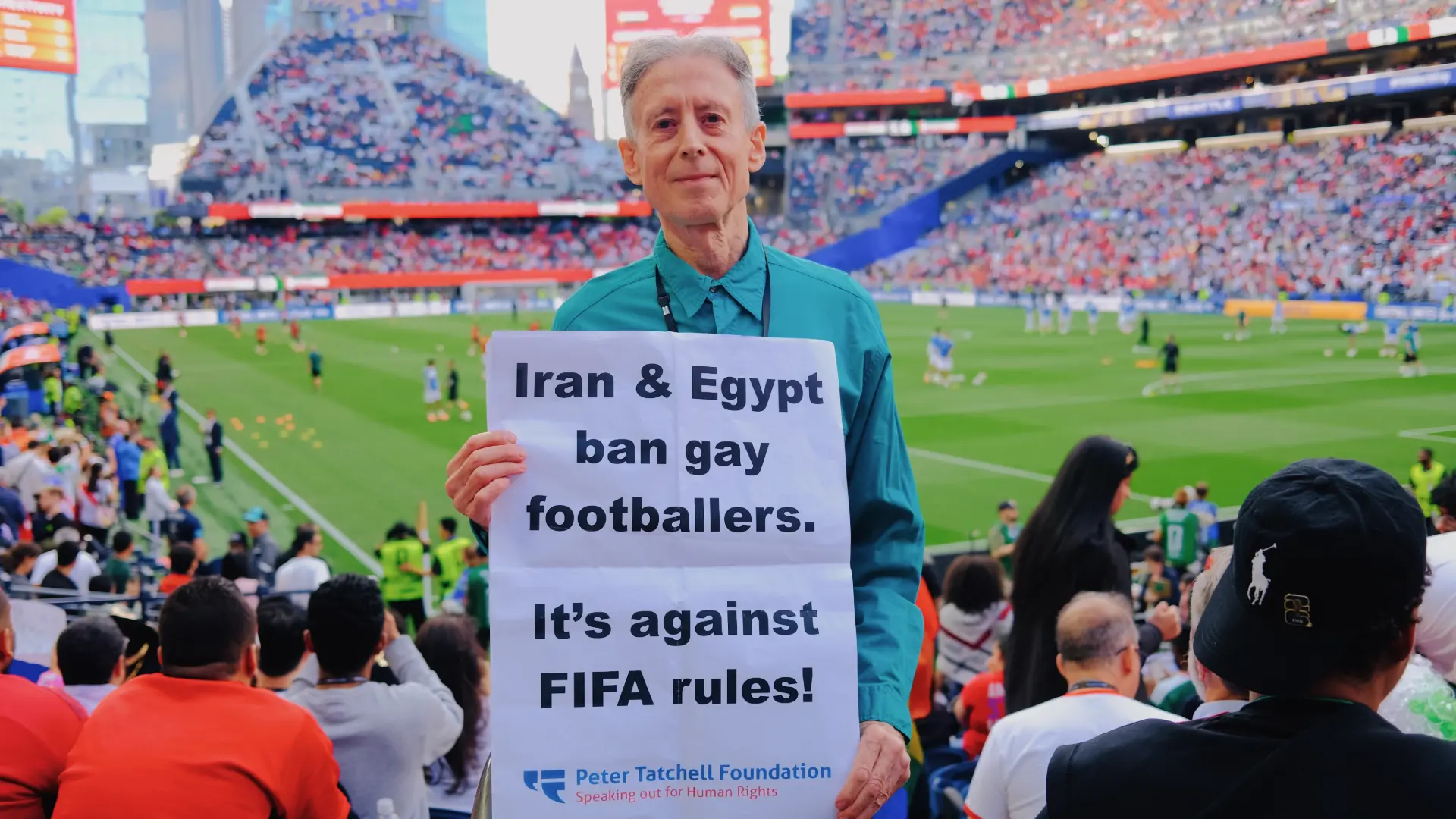
Peter Tatchell held a protest inside Seattle Stadium during the 2026 FIFA World Cup Pride Match featuring Iran and Egypt.
The game took place on Friday (26 June), when human rights campaigner Tatchell displayed a placard reading: “Iran & Egypt ban gay footballers. It’s against FIFA rules.” He briefly faced attempts by officials to stop the protest.
Recalling the Pride Match in a news release, he said: “When I unveiled my placard shortly before kick-off, officials got in a huddle with ground staff. They were sent to my seat and ordered me to give them the placard, saying it was prohibited.”
“I refused to hand it over” – Peter Tatchell was unwavered during his protest at the 2026 FIFA World Cup Pride Match
“I refused to hand it over, saying that FIFA and the Seattle organising committee had authorised LGBT+ messages,” Tatchell continued. “The staff then went away to consult further with officials. They returned and said I could keep my protest placard but must not leave my seat.”
Tatchell forewarned his protest in a letter written to FIFA last week, urging the organisation to take action against the 11 World Cup nations with anti-gay laws, two of which are Iran and Egypt.
Following the announcement late last year that the two nations would play in the 2026 World Cup Pride Match, Iran and Egypt condemned any association with the LGBTQ+ community.
Egypt and Iran complain to FIFA
In December 2025, Egypt’s Football Association (EFA) sent a letter to FIFA requesting that any affiliation with the LGBTQ+ community be prevented, due to the religious and social values of both nations.
Iran made similar demands in May 2026, requesting that only officially recognised national flags be displayed in stadiums, thereby banning rainbow Pride flags.
Days before the Pride Match, Iran’s head coach, Amir Ghalenoei, admitted that LGBTQ+ matters are “banned in our league” at a press conference on 25 June.
“That is the glaring contradiction FIFA refuses to confront” – Tatchell condemns Egypt and Iran’s Pride Match
Tatchell argued that Ghalenoei was implying that gay players are not permitted in their team, which is against FIFA’s anti-discrimination rules for the World Cup.
“This is a Pride Match between two countries where homosexuality is criminalised. That is the glaring contradiction FIFA refuses to confront,” Tatchell stated.
“These countries, because of their official state-sanctioned homophobia, have a de facto ban on gay footballers in their World Cup teams. A gay footballer good enough to play for Iran or Egypt would be more likely to face imprisonment than selection for the national squad,” he continued.
What does FIFA say about discrimination against gay players?
“FIFA’s own rules prohibit discrimination on the grounds of sexual orientation. Yet FIFA is allowing countries that criminalise homosexuality to compete without requiring them to confirm that gay players are eligible for selection.”
As per FIFA statutes and regulations, Tatchell argues that discrimination against gay players would be a breach of FIFA Statutes – Article 3: Human Rights.
Tatchell also draws attention to FIFA Statutes – Article 4.1: Non-discrimination, Equality and Neutrality, which prohibits discrimination on the grounds of sexual orientation.
FIFA’s Human Rights Team fails to answer Tatchell’s main question
FIFA’s Human Rights Team replied to the letter on 23 June but failed to answer the central question: whether FIFA had asked Iran, Egypt, or the other named national associations to confirm that gay footballers would be eligible for selection.
Tatchell claimed that FIFA shifted responsibility back to the national associations after the Human Rights Team wrote: “The selection of players is the responsibility of the respective participating FIFA member associations.”
Last week, Hedda McLendon, Seattle FQC26’s senior vice president of legacy, confirmed to Outsports that the Pride Match would go ahead despite public concern.
“Rainbow flags in the stands are not enough” – Tatchell calling for answers over ongoing concern
“We anticipate a lot of rainbow flags in the stadium and T-shirts with rainbow flags on them,” said McLendon.
“Let’s welcome people to Seattle. It’s the World Cup. And let’s show them how we Pride. It’s not a day, it’s not a weekend here. It’s a month.”
Tatchell argued that Pride flags are not enough and that FIFA needs to take action: “Rainbow flags in the stands are not enough if gay players are excluded from the pitch.”