
Queer representation in gaming changing the landscape
Charting queerness in the world of gaming
By Ashley Davey
Gaming has always been about escapism. But for many LGBTQ+ players, it has offered something more intimate: a place to test identity, imagine freedom and exist, however briefly, beyond the judgement of the real world. As a bullied, ostracised kid growing up in Yorkshire in the late 90s and early 2000s, gaming offered me a safe haven in which to explore my identity without fear of discovery, long before queer visibility became a mainstream talking point in entertainment.
There’s no denying that the history of LGBTQ+ representation in gaming is messy. For years, if LGBTQ+ people appeared at all, they were often one-dimensional stereotypes, framed as threatening, deviant or comic. Much like queer-coded cartoon Disney villains, early games frequently used flamboyance, androgyny or gender-nonconformity as shorthand for menace. For queer players, it created a strange tension: they saw glimpses of themselves on screen, but only through characters designed to be feared, mocked or defeated. Visibility existed, but on deeply compromised terms.
The Sims
The real shift came when games began allowing queerness to exist not as something to be mocked, but as part of ordinary life. The 2000s brought progress through player choice. A landmark moment came with The Sims, where players could engage in same-sex relationships right from the game’s launch in 2000 – something that was unusual for a mainstream title to embrace at the time. In truth, the inclusion was accidental, as the developers released an older build of The Sims, in which all Sims could pursue relationships with either sex, with their romantic behaviour shaped by the player’s choices. Don Hopkins, a key programmer of The Sims, gave a scathing response when the developers wanted to remove same-sex relationships from the original build, stating that anyone offended by their inclusion in a simulation needed to “grow up and get a life”. What made it feel radical was not that the game made a grand political statement, but rather that it didn’t. Queer relationships were simply treated with the same emotional logic as straight ones. In hindsight, that quiet normalisation was revolutionary.
The Last of Us
Then came the moment blockbuster storytelling stopped merely accommodating queer players and started speaking directly to them. For me, that moment arrived with The Last of Us. Ellie’s sexuality, revealed in the Left Behind downloadable content, felt like a genuine watershed moment for a major game studio title. What struck me most was how unceremonious the revelation felt. There was no tortured reveal or moral lesson. Ellie liked girls. That was it. And that matter-of-factness made it all the more powerful.
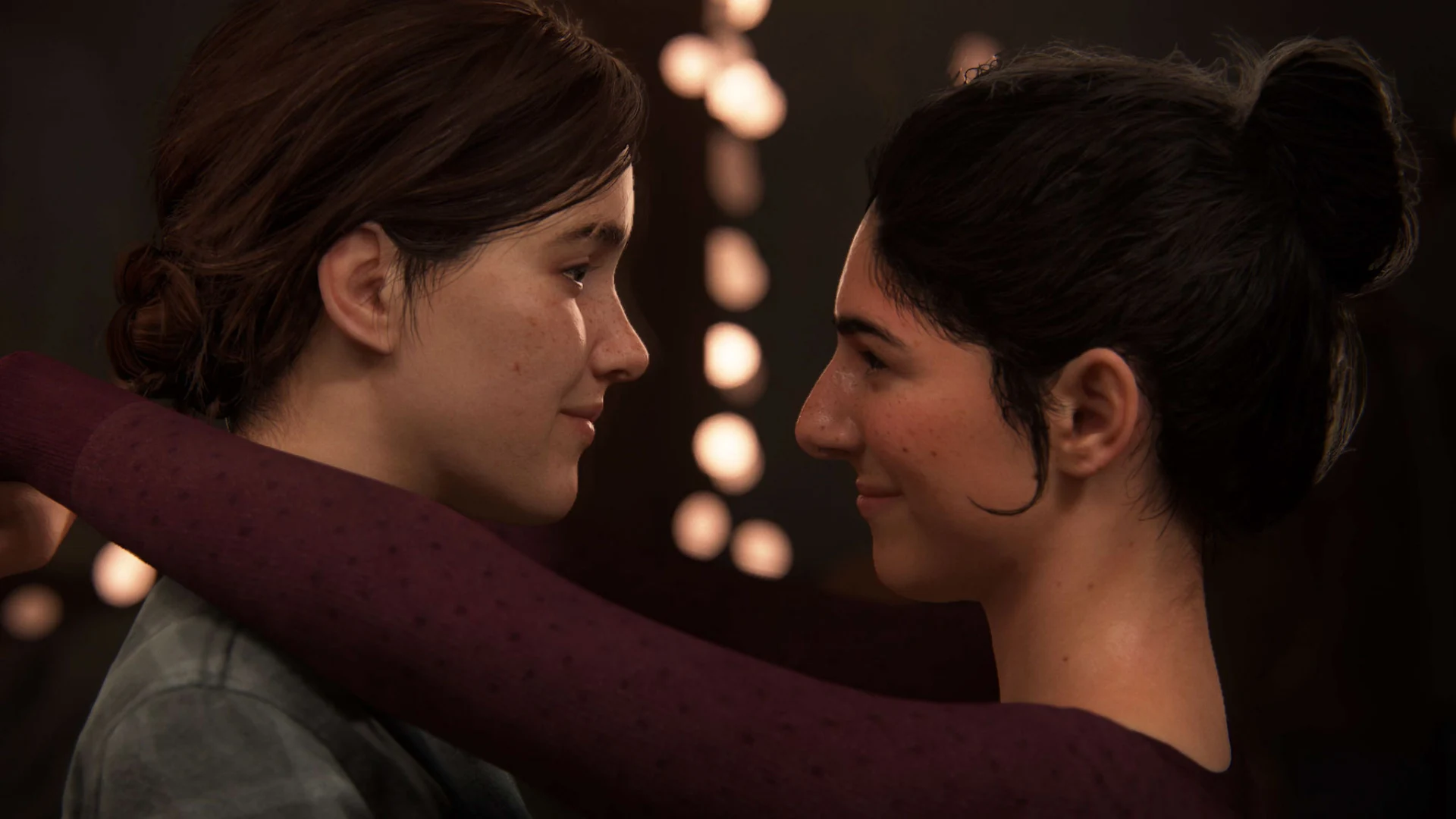
Its sequel, The Last of Us Part II, pushed representation further. It placed Ellie’s romantic relationship with Dina at the emotional centre of the story – with Ellie played by Ashley Johnson and Shannon Woodward portraying Dina (pictured). The game sequel also introduced Lev, a trans character whose presence signalled a willingness to tell expansive queer stories in blockbuster games.
Room for representation
The industry is still far from perfect. For every breakthrough, there remains a familiar chorus insisting inclusion is only “political” when queer people are involved. Although toxicity, harassment and culture war backlash remain, it is clear that things are changing.
What once felt like a hidden refuge is becoming more visible and assured – proof that queer people do not belong on the sidelines of these stories, but at their very centre. For anyone who grew up searching for themselves in pixels, that shift feels nothing short of profound.
This is a feature appearing in issue 371 of Attitude magazine, on sale in print and digital now. Order Attitude magazine issue 371 in print now, or in digital on the links below on Apple News+ and the Attitude app.