
Zander Murray says football’s ‘manosphere’ problem is fuelling homophobia (EXCLUSIVE)
Attitude caught up with the former striker at The Den, home of Millwall FC, where Millwall Romans were launching The Pride Playbook
By Callum Wells
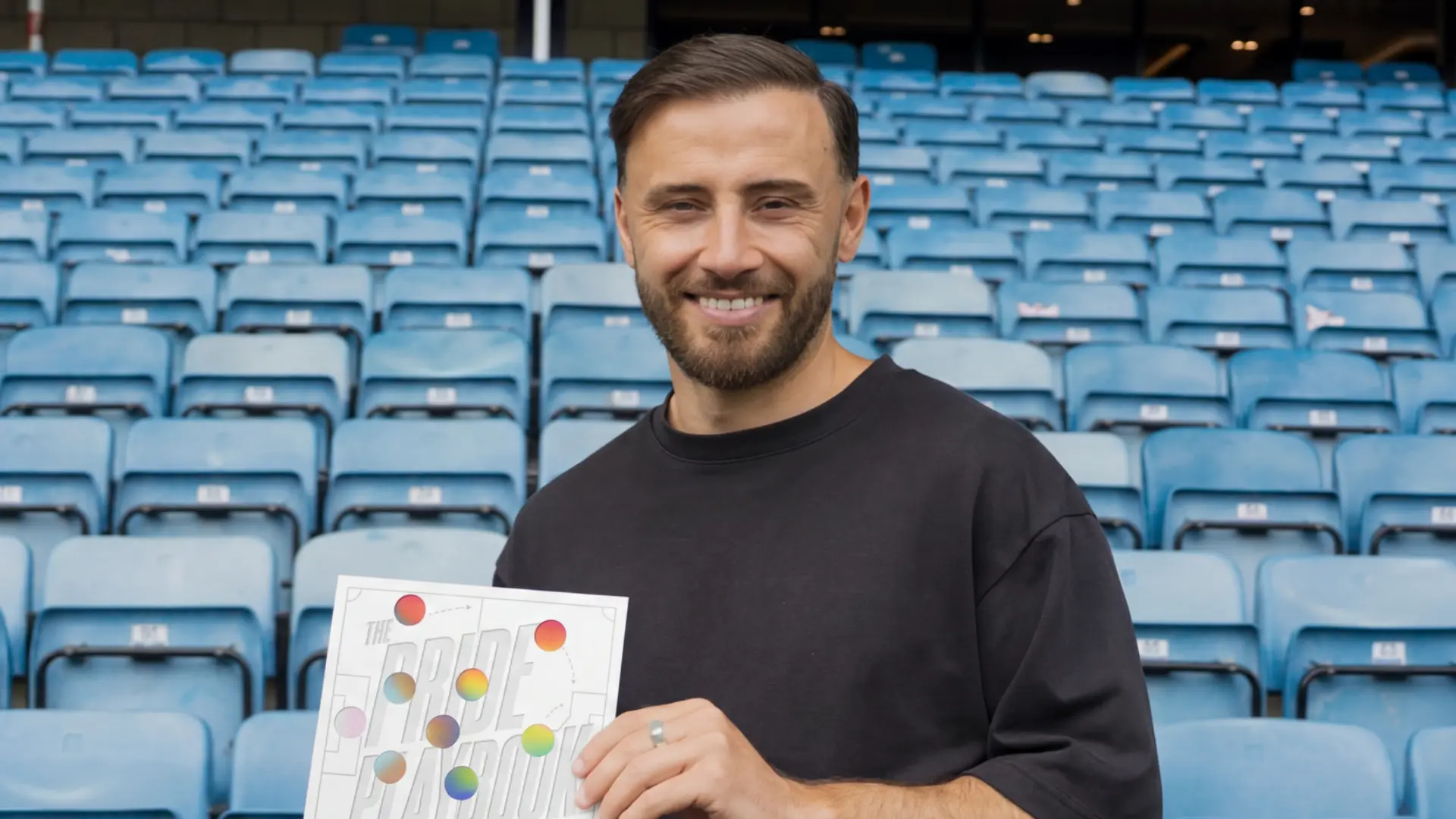
When Zander Murray came out as gay in 2022, he became the first Scottish senior men’s footballer to do so.
Four years later, the former striker is still using his platform to challenge homophobia in the game. We caught up with the former striker at The Den, home of Millwall FC, where Millwall Romans – the club’s LGBTQ+ team – were launching The Pride Playbook, a new guide aimed at helping more professional clubs support LGBTQ+ players and teams.
Speaking to Attitude, Murray reflects on the response to his coming out, why some players still feel unable to be themselves, and raises concerns about the growing influence of the “manosphere” on football culture.
Attitude: When you first came out in 2022, you became the first Scottish men’s footballer to do so. Looking back, what surprised you most about the reaction?
That there are so many people out there that are going through it. From all walks of life, you’re not alone. There’s just so many people that are going through such a tough time with their sexuality.
When you’ve done something like that, particularly in a hyper-masculine environment, then you can take that on as your responsibility to change the narrative and help the world, which four years in, I’d like to think I’ve done that as much as I can. Putting myself in really difficult situations like going to schools, speaking to football clubs, academies, doing roadshow talks around rural areas, speaking to potential naysayers and doing as much press as possible, and just being present. Being a positive presence to help people suffering and struggling with their sexuality.
I think I’m lucky in terms of my upbringing. In London you call it the ends, in Glasgow we call it the scheme, in England they call it the council estate. Being brought up in a council estate has given me that hard exterior that I’ve kind of stuck with for a lot of my life, so I can handle a lot of situations.
We’re all different. You can’t just put LGBTQ+ people into one box. I have masculine traits. I like to play football. I think I can help change the conversation and help dim homophobia in environments that are hyper-masculine. I think that’s my superpower, definitely.
What’s the biggest thing still stopping players from being open about who they are?
They’re terrified of the consequences because they see social media and they think, “Oh my God, I’m gonna get so much abuse and hatred. It’s not gonna work for me, it’s gonna be horrible.”
When actually, in reality, it’s not really like that. You’re not gonna get that much hate, as much as you think. Similarly, you’re gonna get an outpouring of love, which you really need to understand. You’re gonna be an absolute hero for people and you’re going to save people’s lives.
Once people understand that, I think that’s going to help so many people come out and be their authentic selves because, for me, that’s incredible. I can think on two hands now, from whatever I’ve done – documentaries, interviews, talks – that someone has either said to me, to my face or in a letter or in a message, “Zander, you’ve saved my life.”
That will not only be me – that’s a collective of footballers. It’s quite overwhelming to actually grasp that. Sometimes you’re getting messages saying you’ve saved someone’s life, but then on the flip side you’re getting horrible abuse. It’s quite weird to compute that in your brain.
But like any sort of naysayer, I always message them. I say, “Look, if you’re in the vicinity of where I’m from, let’s meet for a coffee. I’ll happily sit you down and I’ll show you the messages that I get and tell you why I’m doing what I’m doing and why it’s really important.”
Do they meet me for a coffee? No, they don’t. But you can only try.
How did you navigate the responsibility that came with coming out? Were you expecting it?
No. As soon as I typed the Facebook post, I had a little sleep and woke up to my phone going crazy.
I didn’t think it would be a big deal. Obviously it put things in its way and then, jeez Louise.
That’s why whenever interventions like this and The Pride Playbook come along, and having the honour to write the foreword, I just feel that any person reading that foreword who’s struggling, I hope that touches their heartstrings and helps them come out and be their authentic self.
Four years in now, I pick and choose what I want to do. I do a lot of mainstream work. I’m hosting the Commonwealth Games, doing a lot of work there and around the World Cup, which is nice because you’re quietly helping the cause.
But in the LGBTQ+ sphere and in football, whenever I think it’s a really powerful project that can save people’s lives and help people, then I’m all for it. The work that’s done here with Millwall Romans has been really uplifting. It was nice to hear and see the connection that they’ve got, and to be part of this playbook to hopefully build more LGBTQ+ football teams and a connection with the clubs, I think it’s magnificent.
Millwall is currently the only professional club to fully integrate and support an LGBTQ+ team. What’s your message to clubs that haven’t followed suit?
I think listen and hear from Millwall and hear from the Romans and see the sort of connection and what it’s done.
We sat and heard from the Romans today and they were saying that at the end of the season it enabled one of them to be their authentic self and come out.
Me just saying that sounds like such a simple thing, but it’s so layered. It can be so difficult and challenging for someone to come out and be their authentic self and, again, potentially it could have saved their life.
Say, for example, they were a Millwall fan and they’re feeling that connection with the football club. I think it’s just so important because I know all too well someone who’s fallen away from football because the club that they’ve loved from a young age, they came out to the supporters’ bus and then they all just rejected them and stopped being their friend. I’ve seen that example happen many times.
To have that connection with the club and an LGBTQ+ team is so, so important.
I would love for many clubs to just listen to Millwall and see what’s been done here, see the playbook and follow suit because it’s gonna have a massive impact on people’s lives. That’s everything I want to be involved in.
What’s the difference between putting out a rainbow flag during Pride Month and creating meaningful change?
I think they go together, of course. It’s a holistic approach you want to take to inclusion in general.
If you want to just put a Pride flag up and do nothing else behind that, then that’s not great, is it?
But if you’re gonna have a year-long programme of inclusion interventions and programmes that make people feel included, I think that’s where the magic happens.
Whether we like it or not, particularly in this day and age, we’ve got a massive battle against us. But if we can continue to win people over and make some of them – not all of them, because you can’t polish a turd – understand the cause, understand why it’s important, understand why initiatives like this are so key for people’s lives, it’s incredible.
I like to hope that I play a part in that, as well as many other people in our world. Sometimes quietly, sometimes loudly where it needs to be – waving Pride flags – but behind that actually doing the real work and having these conversations.
It’s massive. It’s people’s livelihoods, it’s people’s lives we are helping and supporting.
If we can help that guy at the pub with his mates question one of his pals for being homophobic or transphobic, amazing.
More than 80% of LGBTQ+ fans say they’ve witnessed or experienced homophobic behaviour around football. Does that figure shock you?
No. No, no, because football, at its heart and its core, is a working-class sport.
I don’t think a lot of men’s upbringing has a lot of LGBTQ+ education in it. And, dare I say it, who they’re getting their news or information from are not savoury characters, shall we say.
Particularly online, the manosphere and all this nonsense.
I saw one of these videos where a group of fans come up and start shouting, “Death to all gays.” Celebrating that. I think that’s so worrying and troubling.
If we can continue to break that down, break those barriers, and say, “We’re just normal people like you. Stop listening to these toxic, dangerous human beings,” then that’s important.
So no, it doesn’t shock me at all.
In recent years we’ve seen some businesses and organisations scale back diversity initiatives. Do you worry football could do the same?
Yeah. There’s a lot of companies and organisations that have stopped supporting Pride organisations or they’re cutting DEI.
In terms of cutting DEI, yeah, we could probably see that within the football sphere also. It just shows you that because it’s not prominent and it’s not popular and it’s not a thing anymore, companies can just be like, “Away you go,” just because another toxic man online is speaking about it.
That’s why initiatives like this, and continued initiatives like this, are so, so important.
Obviously we’re talking about football here, but we need to continue to get the people in the middle. You’re always going to have the LGBTQ+ people on board and you’re always going to have the naysayers, but then you’ve got this middle group who are a bit unsure. They just don’t know what they think and what they feel.
If we can continue to pull them more towards us, giving them real lived experience, giving them a real understanding of how important inclusion is to human beings’ lives, that’s where I feel the magic lies.
That’s how we continue to influence the policymakers or the decision-makers who give us funding, for example. That’s where I feel the magic lies.
Fans can explore the Millwall Romans Pride Playbook here.