
Death Note: The Musical at the Barbican Centre, London review: Theatre as life force
"Propulsive, passionate, and precision-tooled for greatness," writes Attitude's Jamie Tabberer of this blockbuster adaptation of the 2003 Japanese manga series by Tsugumi Ohba and Takeshi Obata
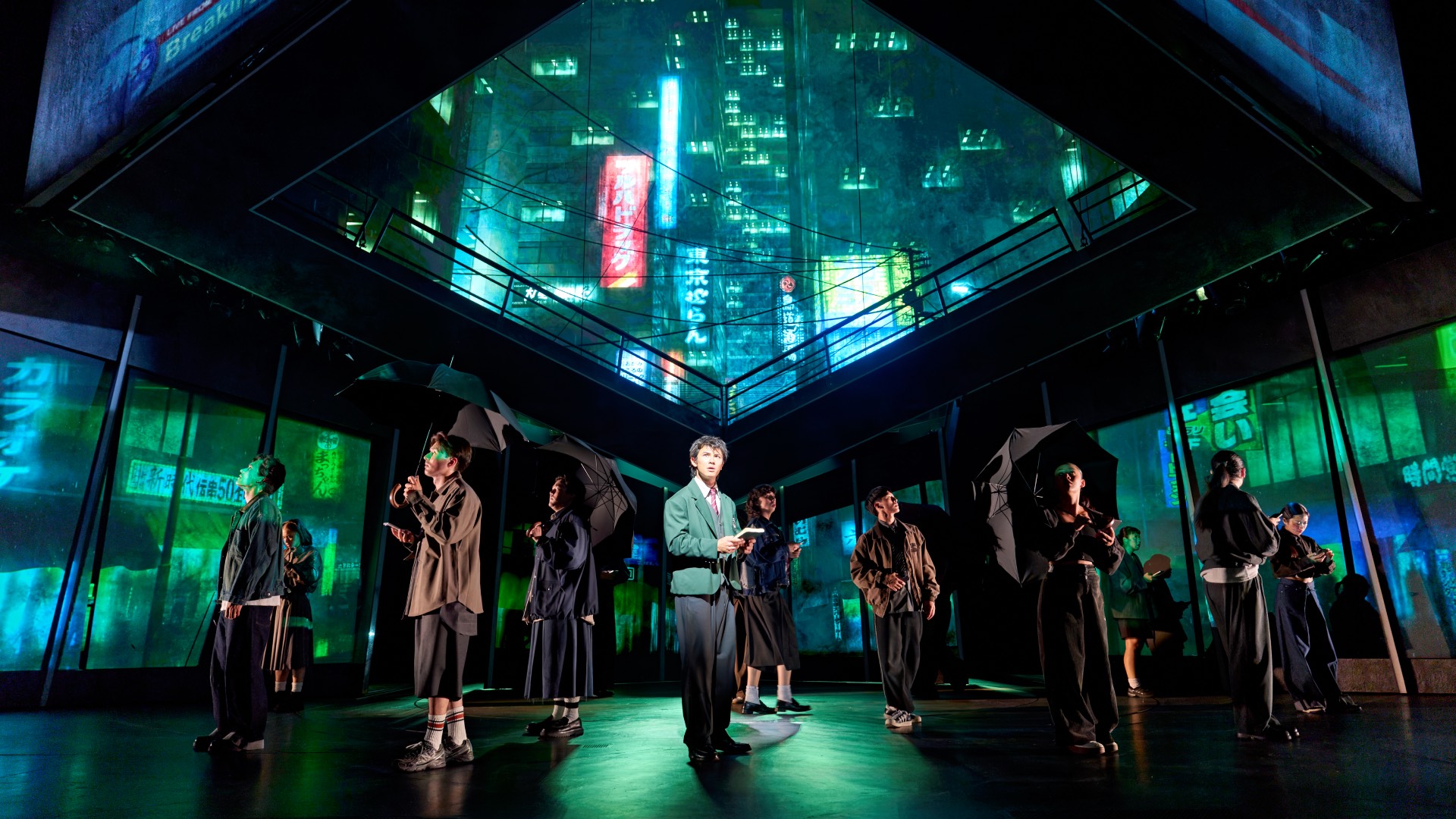
A troupe of dancers ‘giving hurricane’ is usually the stuff of amateur theatre nightmares, but in Death Note: The Musical, the choreography – propulsive, passionate, and precision-tooled for greatness; the same can be said for the writing, acting, music and stagecraft – leaves you slack-jawed. How it’s on for only five weeks as opposed to five years is incomprehensible.
Imagine the experience of this reviewer, arriving at the Barbican Centre in London a complete newcomer to the 2003 Japanese manga series by Tsugumi Ohba and Takeshi Obata, on which the show is based, and this absurdly intricate and yet uniquely accessible and satisfying story.
In it, justice-obsessed student, Light – an inexhaustible, immensely likeable Xander Pang – stumbles on a magical notebook granting him the power to kill anyone whose name he writes inside it. Criminals promptly begin dying ad nauseam; Xander’s doting dad, naturally, is the head of the National Police Agency.
As the self-styled vigilante becomes drunk on power, non-criminals become pawns in his game. An astonishing set piece involving an innocent bystander and a moving train is the highpoint: the bombastic sound followed by sparseness quiet enough for you to hear the sound of your own clipped breath may cause dissociation.
If you too are a Death Note newbie, resist the urge to research it beforehand. It was slightly deflating, during the interval, for Attitude to learn of the capitalistic behemoth this story has become. Countless films, TV shows, video games and indeed stage productions precede this one – but perhaps this level of quality is only possible through decades of course correction, and besides, we’d take a rinse and repeat of this over Harry Potter any day.
For sure, the world is crying out for fresh stories, but this twisted adult fairytale needs to be told over and over again, as it gets you thinking about vital subjects that we all avoid, like the subjectivity of morality and the fragility of life.
The presence of supernatural Shinigami, or ‘gods of death’, ought to strain credibility, but are handled with such mature, sublime taste (“grotesque, but make it fashion,” you imagine costume designer Sachiko Nakahara insisting, resisting the urge to depict them as panto villains; breathtaking work indeed) that they begin to feel uncomfortably plausible. All three Shinigami – Colin Ryan as the darkly comic L especially – are utter perfection.
Elsewhere, Colin Ryan’s indescribable performance as detective L – so intense and hyper focused in his pursuit of solving the case, you feel you’re witnessing a person living life at a deeply uncomfortable and absolute extreme – should win awards.
It’s very hard to find fault with Ivan Menchell’s book and Stephen Whitson direction, but under extremely close scrutiny, there are blemishes – strained singing, a slight over-use of big screen special effects that distracts from the physical scenography, including an insanely impressive skybridge – but the action moves at such rapid speed, they barely register.
For a story and show of such passion and depth, with enough energising bops and outfits to make Lady Gaga and HUNTR/X weep, you wonder if something other than abject nihility could be mined from the ending. That said, we’re sure we’ll remember it forever… long after the saccharine conclusions of various West End crowdpleasers have died from our memories.
For more information, visit Barbican.org.