Attitude revisits Moldova Pride 2024: a country slowly emerging from its past to carve a new queer identity
Moldovan or not, activist or not, queer or not – of all ages and backgrounds join in the festivities
The first time I came to Moldova’s capital city of Chișinău (pronounced key-she-now), it was in the snowy heart of winter, and the café across the street seemed to only play French covers of American Christmas songs – tracks which, as a Franco-American woman, I could not help but find equal parts endearing and ludicrous, familiar and foreign.
Moldova, a thin slice of land separating Ukraine and Romania, is a country constantly at the crossroads of global influence: historically cleaved between Russian dominance, the Ottoman reign, Romanian alliances, and the whims of continental powers that barely know it exists. Even Moldova is not sure of its identity. My Moldovan friends say, “Moldova does not know who it is. Moldova does not know what it wants.” Usually, they end such statements with some variation of, “We need to change that.”
The second time I visit is in June this year, and the snow has been replaced by lush greenery. I’m standing in front of the café mentioned above when a friend happens upon me, jubilant yet confused.
“Why in the world did you come back to Moldova?”
“To visit all of you again,” I reply, “and, of course, for Pride.”
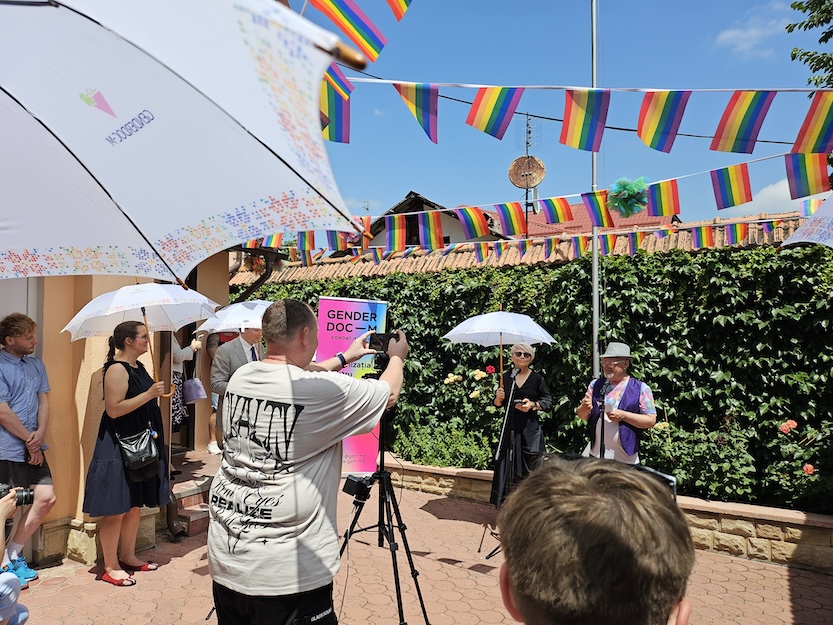
Raising the flag at GenderDoc-M for Moldova Pride
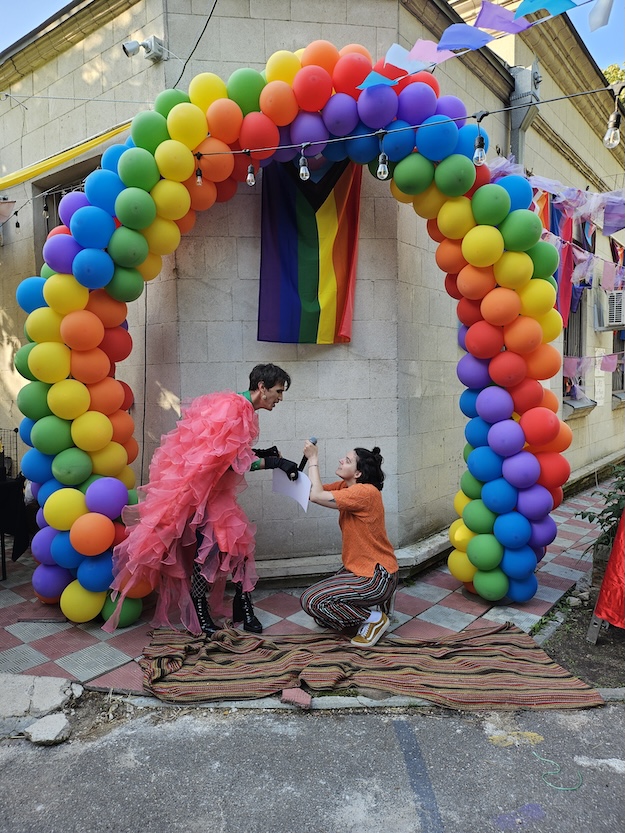
On the first day of Pride Week, the flag goes up at GenderDoc-M, Moldova’s only LGBTQ+ advocacy group, and the summer heat beats down on us in the yard of their headquarters, a modest home in a residential area. A rainbow flag with the words “Moldova Pride” seared onto it in black, blocky type is hoisted to a bombastic score.
Of the 30 or so people packed in here, most are Moldovans, some are ambassadors – suited and sweaty – from supportive nations, and I (as is often the case) am the odd one out, here simply for my friends.
Although I have spent only four weeks in Moldova, I have met several of the country’s LGBTQ+ activists – something I could not claim about Miami despite my years of advocacy there. Moldova has a small population of around 2.5 million, but the speed of my introduction to its queer community is entirely thanks to my first and closest Moldovan friend, Stela, an almost overwhelmingly sharp and sincere woman who immediately set about introducing me to her web of outsiders.
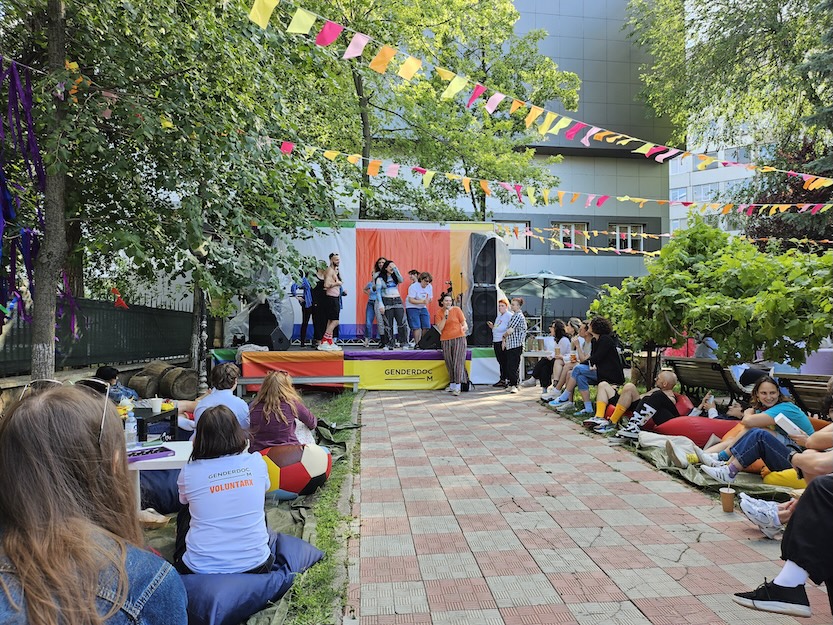
Back in the courtyard, awards are given to those who have made outstanding contributions to the local LGBTQ+ community, and we cheer them in gratitude. As if from nowhere, food and sparkling Moldovan wine appear. As if from nothing, a community thrives.
Strachina de Jmalț anti-awards – where homophobes and transphobes are ridiculed
Stela nudges my shoulder and points at the screen. “That was filmed in our yard!” she exclaims. She and her girlfriend moved into a house with another lesbian couple just a few months ago, and she is unable to hide the sense of belonging this arrangement affords her.
We are seated at the Strachina de Jmalț, or Enamel Bowl, for the annual queer anti-awards, where Moldova’s most prominent homophobes and transphobes are awarded in absentia for their ‘contributions’, receiving various containers fit for only the finest trash.
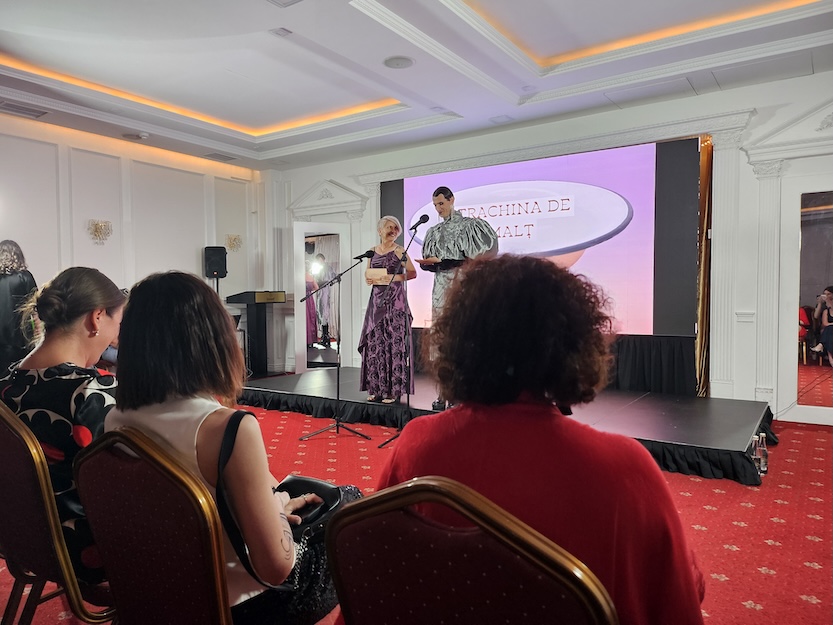
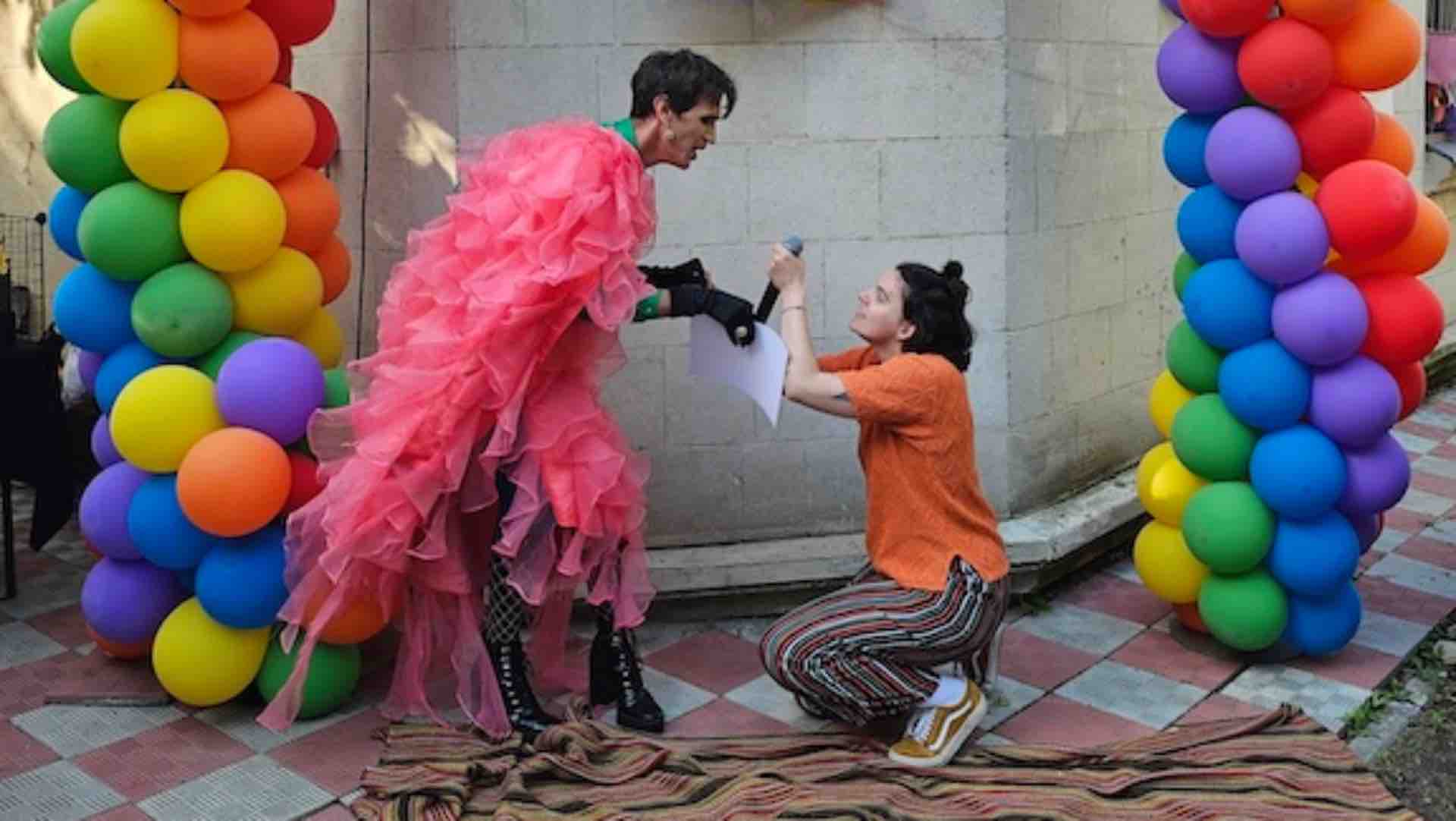
The ceremony, taking place in a room at a local events centre, is hosted by Angelica, longtime head of GenderDoc-M, and Pavel, a theatre art director with an immense talent for drag, performing under the stage name Medea. Interspersed between the categories are prerecorded, slapstick skits from Stela’s backyard, in which Medea fumbles over the ‘awards’.
Former president of Moldova and conservative Russophile Igor Dodon, Chișinău mayor Ion Ceban were up for “awards”
The speculation as to who will win this year is fevered. To all the fans at home, I dare say there are some renowned competitors in the running: former president of Moldova and conservative Russophile Igor Dodon, Chișinău mayor Ion Ceban (who tried and failed to cancel a Pride march), and a wildly hateful pastor whose name bears not repeating.
A pause. The crowd holds their breath. And the pastor receives the grand prize! A bright green plastic bucket is presented to the tune of ‘The Imperial March’ from Star Wars. But do not be fooled, ladies and gentlemen, binary and non, for this only heightens the buzz surrounding the real prize: the people’s choice award.
And, this year, there is a dark horse in the race. A well-regarded theatre actress went on an inflammatory podcast and when asked did not hide her disgust for us queers. Tension mounts in the air – we can barely contain our excitement. Medea smirks. And the winner is… the actress! Well, folks, let this be your reminder not to mess with a queen.
Moldova’s art, language, history and shared pain
At various points on the day of the awards, I find myself immersed in artistic conversation. Before the awards I meet Doy, a filmmaker working on a documentary about their relationship with their identical twin sister. Following Doy’s decision to embrace their polycystic ovary syndrome, grow out their beard and present in a less feminine manner, the two of them have grown apart.
As has become routine in my interactions, I am hampered by my inability to speak either Romanian, Moldova’s mother tongue, or Russian, its second language. Instead, Doy mostly understands my English, I mostly understand their Italian, and we grow close as we share our pain.
Following the awards, we make our way to Marlène, a bar where the equivalent of five pounds sterling will net you one of the best cocktails of your life. I sheepishly thank Angelica, who wears a clean-cut look appropriate for a queer public figure, for welcoming me into this fold.
I also meet her significant other, Leo, a masculine nonbinary person who works at GenderDoc-M and has filmmaking aspirations. We discuss directors ranging from Belgian director Chantal Akerman to Pedro Almodóvar, and he tells me about his ambition to create a movie about Moldova’s early queer movement – in particular, how the first attempted Pride March in 2008 was overrun by a mob that surrounded the bus GenderDoc had rented. The event deeply marked all those on board, Angelica included.
This is an excerpt from a feature appearing in Attitude’s Jan/Feb 2025 issue.
Subscribe to Attitude magazine in print, download the Attitude app, and follow Attitude on Apple News+. Plus, find Attitude on Instagram, Facebook, TikTok, X and YouTube.