The amazing legacy of Brokeback Mountain as it turns 20: ‘I wish I knew how to quit you’
As the Oscar-winning romance starring Jake Gyllenhaaland the late Heath Ledger turns 20, Attitude revisits the iconic film’s storied legacy
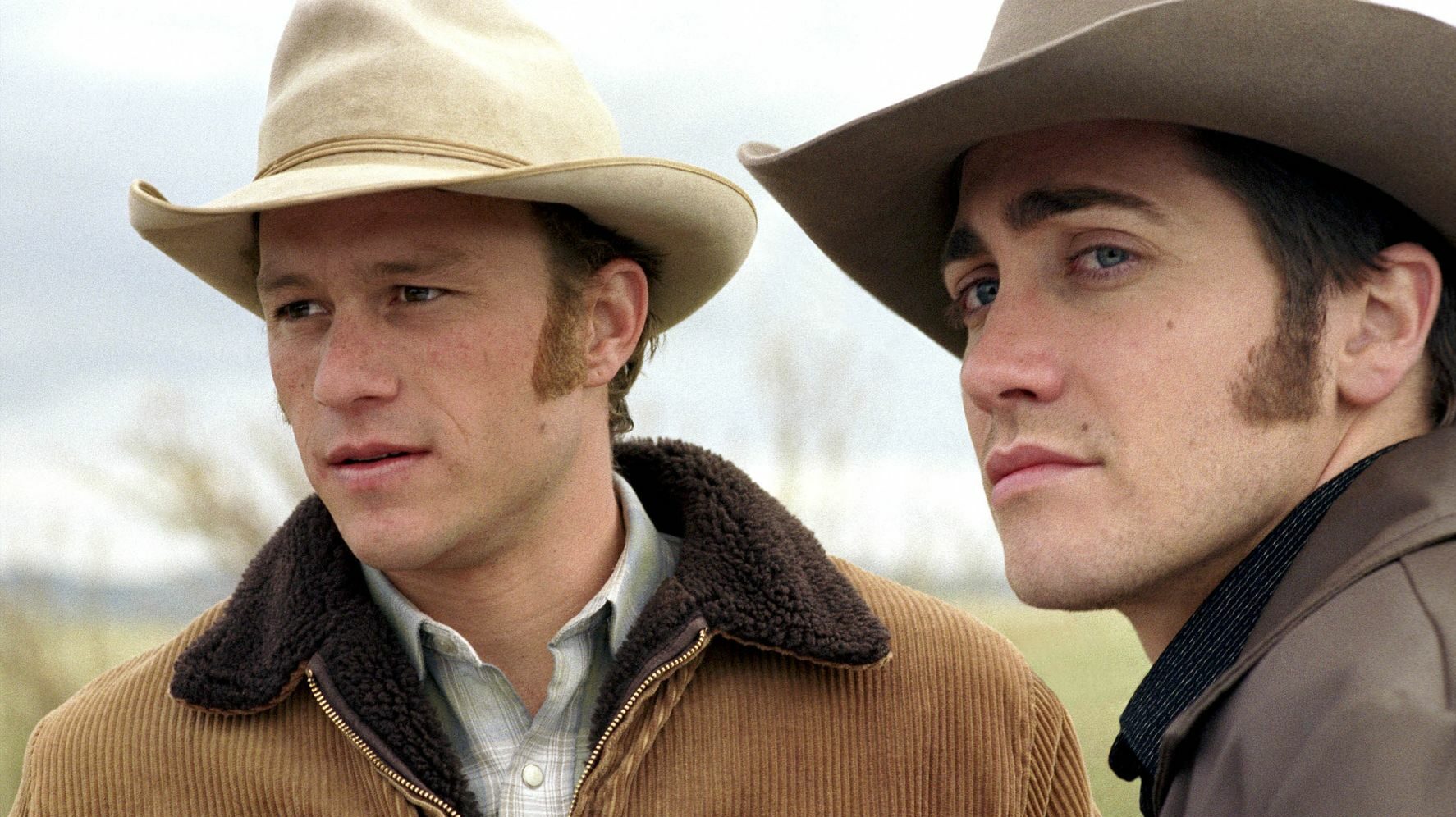
“But how did they decide… who fucked who?” a sheepish, flummoxed straight guy once asked me of that first sex scene in Brokeback Mountain, when camping cowboys Jack (Jake Gyllenhaal) and Ennis (the late Heath Ledger) go from awkward embrace to aggressive fucking – with spit for lube! – in seconds. No discussion, no negotiation, no douching – just primal, animal urge. That question sums up what I loved about the cultural permission slip that was this triple-Oscar-winning movie and bona fide phenomenon. It sparked mass, unprecedented conversations about queer intimacy, even among straight people, that previously went under the radar or ended in punchlines. I was amazed, for example, when a female friend told me Jack and Ennis were the first pair of guys she’d ever fantasised about. Such an admission is no big deal today, but I respected her so much for it at the time.
It’s touching, then, to read Ledger’s 2005 Attitude cover interview and have him draw attention, instead, to the film’s second, less-headline-generating, love scene. “[It] had to be more intimate, less brutal,” he remembers. “Because it is the only point where he lets any intimacy in. It was absolutely a conscious decision.”
It can’t be overstated how groundbreaking Brokeback Mountain actually was when it went on general release in UK cinemas in January 2006
It can’t be overstated how groundbreaking Brokeback Mountain actually was when it went on general release in UK cinemas in January 2006. It’s still hard for independent films – especially purposely gritty, hyper-realistic, glacially paced ones – to compete with glossy blockbusters, but director Ang Lee’s masterpiece grossed $178 million worldwide on a $14 million budget and remains the highest-grossing queer-themed film of all time. (Yes, The Imitation Game and Rocketman grossed more, but in those cases, queerness was arguably secondary to themes of Second World War codebreaking and Elton John’s music career.) Its directness is pretty impressive, even by today’s standards, and saw the film banned in China and parts of the Middle East, while the American Family Association urged boycotts of cinemas, claiming Hollywood was “promoting homosexuality through a Western”.
Not that Ledger welcomed the “gay cowboy movie” tag that spread like wildfire. “The pure fact of it is it transcends a label; it’s human,” he said at the Berlinale press conference in 2006. “It’s a story of two human beings, two souls that are in love. It’s like, get over the fact that there’s two men – that’s the point!” And in the interest of fighting bi-erasure, it’s worth noting Ennis, and to a lesser extent Jack, have genuine, if ultimately unsatisfying romantic and sexual relationships with their wives. (Ennis’s wife Alma was played by Michelle Williams, and Jack’s wife Lureen was played by a pre-The Devil Wears Prada Anne Hathaway.)
Gyllenhaal, in fact, weathered controversy in the 2000s for repeatedly sharing his view that Jack and Ennis (as per Details magazine) are “actually two straight guys who fall in love”.
Interestingly, it’s Jack, not Ennis, who pursues sex with other men and pushes Ennis to take their love to the next level. By 2015, Gyllenhaal’s perception had changed. “[My] character is very specifically the more overtly gay character of the two,” he said. “The one who’s struggling with it less. And I didn’t really realise that. And that was an interesting journey for me, giving in to that idea. Being the one who tries to push the relationship.” In the end, of course, Jack receives the ultimate punishment from a violently homophobic society for this. Ennis’s queerness, meanwhile, begins and ends with Jack. Were the film set in the modern day, I can easily imagine this man of famously few words still resisting labels – even “heteroflexible” – and, for better or worse, defining and presenting as straight and benefiting from all the privilege that comes with that.
“It affected me in ways I can’t necessarily put in words, or even would want to talk about publicly” – Jake Gyllenhaal reflecting on Heath Ledger’s 2008 death
That’s not to diminish the character. It’s palpably clear that Ennis loves Jack and Jack loves Ennis. It’s a connection to rival Romeo and Juliet’s, perhaps informed by the real-life connection between Ledger and Gyllenhaal. “There are millions of worse things I can think of doing in my life than kissing Jake,” Ledger told Attitude in 2005.
Reflecting on Ledger’s death in 2008 of an accidental overdose of prescription medications, including painkillers, anti-anxiety drugs and sleeping pills, Gyllenhaal told People in 2015: “It affected me in ways I can’t necessarily put in words, or even would want to talk about publicly.”
For all the debates around straight guys playing gay that have swirled in the years since, no other men, regardless of sexuality, could have produced this specific alchemy: a mix of painful vulnerability, tortured masculinity, childlike innocence and hard-won maturity – and, of course, absurd good looks. It’s also to the credit of the film’s director, Lee, and Annie Proulx, who wrote the 1997 short story for the New Yorker the film’s based on, for creating such a convincing queer love story despite being straight.
Call it what you will, but precious few films about same-sex male sex and love have penetrated deeply enough to warrant comparison since. There are critical darlings Moonlight (2016) and Call Me by Your Name (2016), of course, but the frothy, silly Love, Simon (2017), so lovably light and throwaway by comparison, outgrossed both. (A cool $66.7 million worldwide to Moonlight’s $65.2 million and Call Me by Your Name’s $43.1 million.) All are sublime in their own way – but in the cutthroat world of filmmaking, the box office dictates what gets greenlit next. Which is why Billy Eichner’s beautifully well-intentioned Bros – Mariah Carey’s endorsement notwithstanding – was such an unmitigated disaster. Marketed as the first wide-release, major studio, mainstream romantic comedy with two gay male characters as co-leads, it seemed poised to learn from the successes and shortcomings of Brokeback Mountain et al and become the gay Pretty Woman. Instead, it grossed just $14.8 million, with Eichner admitting: “Straight people just didn’t show up.”
Two decades on, the film speaks to the modern condition in more ways than one
If straight people showed up for Brokeback Mountain at the multiplex, they didn’t at the voting box come Oscars night. The film famously lost the Best Picture gong to the embarrassingly bad Crash, leading many to question if an insidious form of heterosexism was to blame. Screen legend Clint Eastwood, for instance, was one of almost 6,000 Academy of Motion Picture Arts and Sciences voting members that year, but when asked about the film at the Cannes Film Festival, merely shrugged: “I’ll tell you the truth, I haven’t seen it.” An overwhelmingly cis-het votership, it seemed, had gravitated away from the “other” and towards what they knew. The episode sheds light on the art of subtle, casual marginalisation that persists today, particularly in political spheres. (Remember that for every key LGBTQ+‑related parliamentary decision, a number of MPs abstain or simply don’t turn up to vote.)
Two decades on, the film speaks to the modern condition in more ways than one: particularly to a gay community in a perpetual state of crisis over masculinity, suffering a dearth of self-love. If Ennis never quite learns to love himself, Ledger, at least, loved him. “I totally fell for him,” the star told Attitude. “I fell for his loneliness and inability to express love. There was so much to discover in him. His battle is almost completely played out within himself. Which is right, because it is a battle against his genetic structure. He is carrying the fears of generations that went before him.”
Subscribe to Attitude magazine in print, download the Attitude app, and follow Attitude on Apple News+. Plus, find Attitude on Instagram, Facebook, TikTok, X and YouTube.