
In 2025, there was plenty of good news outshining a brutal year for the LGBTQ+ community
Even as institutions stalled, hedged, or turned openly hostile, queer communities organised, and found ways to survive anyway
By the end of 2025, it was clear this was not just another difficult year for LGBTQ+ people; it was a year when politics became impossible to ignore.
Across the UK, the US, and beyond, queer lives were increasingly dragged into culture wars, as government policies and media debates fuelled hostility and uncertainty with real consequences for healthcare, education, and personal safety. The scrutiny didn’t stay online or on television screens; it bled into daily life. While the initial shock may have faded, the reality of living under that pressure did not.
Throughout 2025, queer people were forced to keep assessing where it was still safe to exist, speak, or be seen, until it felt less like living through a crisis and more like learning to function inside one. Yet pressure was not the whole story. Even as institutions stalled, hedged, or turned openly hostile, queer communities organised, and found ways to survive anyway.
How the tensions took root and spread
Much of the political pressure that shaped 2025 did not arise in isolation; it spread throughout the year and primarily originated from the United States.

Donald Trump’s return to office not only reshaped federal policy but also influenced public discourse. Across the United States, familiar attacks on transgender healthcare, education, and public life intensified at the state level. This was accompanied by rhetoric that portrayed queer existence as a social threat rather than recognizing it as a valid aspect of human diversity and a lived reality. What made this moment particularly destabilizing was not just the sheer volume of legislation but also how quickly the language around these issues adapted.
Talking points and dog whistles like “gender ideology”, “protecting children” and “biological truth” once limited to American culture wars, have spread globally as slogans. The US didn’t just legislate these ideas; it exported a playbook.
In the UK, transgender issues have become politically contentious, fuelled by a Supreme Court ruling on the legal definition of sex and new guidelines from the Equality and Human Rights Commission regarding single-sex spaces. Trans healthcare is often portrayed as a battleground rather than a public service. Despite the absence of a national election this year, the political climate intensified, reducing personal lives to abstract debates and sparking a widespread moral panic.
Far-right parties across Europe also intensified their attacks on LGBTQ+ rights, using them as part of broader campaigns against civil liberties. In Hungary and Italy, queer visibility and diverse family structures were framed as threats to “traditional values”, while in France and Germany, anti-LGBTQ+ rhetoric was tested for mobilising electoral support.
Even outside of Europe, a similar backlash was actively promoted, much of it originating from the United States. Throughout 2025, US-based evangelical organisations and conservative advocacy groups traveled to various parts of Africa, hosting “family values” conferences and conducting closed-door meetings with lawmakers and religious leaders. These interventions advanced American culture-war narratives concerning sexuality and gender as moral guidance, often disregarding local legal, cultural, and social contexts. In countries mostly in Africa, where protections for LGBTQ+ individuals were already weak, this imported ideology contributed to the legitimisation of draconian laws, fuelled moral panic, and reinforced the notion that queer lives were a foreign threat rather than a lived reality.
When institutions failed, communities didn’t
By mid-2025, it became evident that waiting for institutions to take the lead was no longer sufficient. Courts were delayed, governments were indecisive, and political discussions dragged on while queer individuals faced the repercussions. As a result, communities began to take action.
Throughout the UK, survival became a collective effort. Support networks expanded not because policies improved, but because there was an urgent need for immediate assistance. Legal uncertainty, negative media coverage, and obstacles to healthcare drove people to organize more quickly and locally, transforming care into a vital infrastructure rather than a mere symbol.
When the UK community stepped in
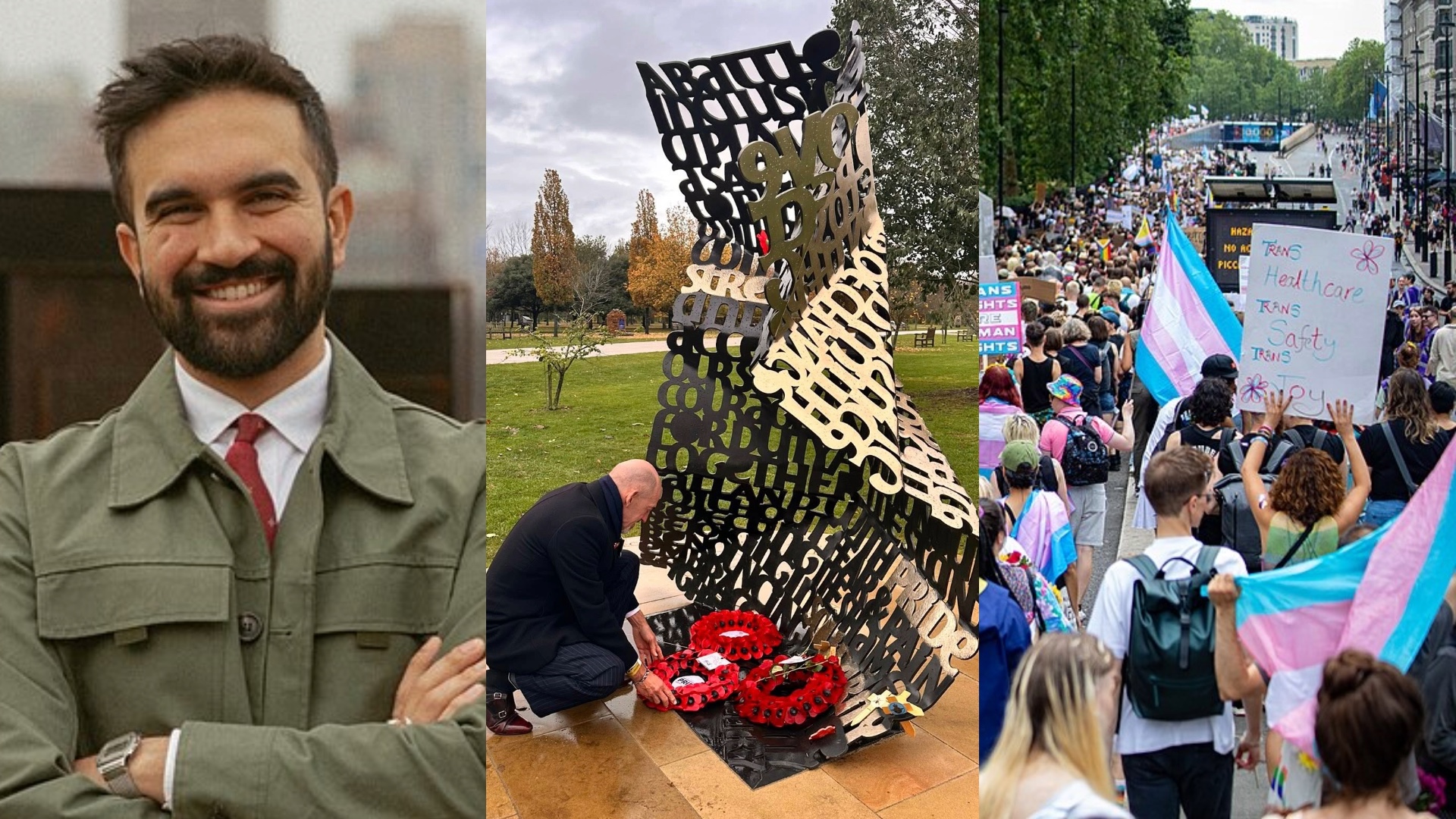
In the UK, one of the clearest responses to political pressure in 2025 came on the streets. London Trans+ Pride drew more than 100,000 people, making it the largest Trans+ Pride event the country has ever seen. After months of hostile headlines and legal uncertainty, the march turned visibility into refusal — reclaiming public space at a moment when trans lives were being politically contested.

This visibility was reflected in more subtle forms of recognition. This year also marked the dedication of the UK’s first national memorial for LGBTQ+ armed forces personnel, unveiled by King Charles III. This event represented a significant moment of official acknowledgment for histories that have often been overlooked.
Where institutions hesitated, communities acted. In the wake of the Supreme Court ruling on the legal definition of sex, grassroots legal networks expanded to help trans people navigate renewed uncertainty. Meanwhile, guidance from the Department for Education confirmed that schools would continue teaching relationships and LGBTQ+ topics from 2026, despite mounting backlash.
The absence of a comprehensive UK ban on conversion practices remained a stark gap. But for many queer people, community networks filled what politics left behind. These efforts weren’t symbolic, they were lifelines, proof that when recognition stalls, organising doesn’t.
The United States: holding the line
In the United States, many significant moments of 2025 focused on defending LGBTQ+ rights rather than expanding them, amid a political climate increasingly hostile to these rights.
The Supreme Court’s decision not to reconsider Kim Davis’s challenge to marriage equality did not advance rights, but it did help preserve them. This effectively maintained the existing protections for same-sex marriage at a time when the possibility of rollbacks felt real. In a year marked by legal uncertainty, simply holding onto what was already in place was significant.
In contrast to federal politics, states like California and New York enacted measures to protect transgender students and ensure access to gender-affirming healthcare. These state-level policies provided crucial support for queer individuals, despite the broader national hostility.
Local elections also reflected this trend, with Zohran Mamdani’s victory in New York City highlighting the importance of LGBTQ+ representation and showing that pro-trans politics is not radioactive. In the corporate sphere, major US companies like Microsoft and Apple enhanced workplace protections, providing some support for queer workers in a politicized environment.
At the same time, legal advocacy groups prepared for what lay ahead. Lambda Legal reported a record-breaking $285 million fundraising haul, dramatically expanding its capacity to challenge discriminatory laws nationwide. While national politics presented threats, resilience emerged through court decisions, state actions, and community organising in the ongoing fight for LGBTQ+ rights in the United States.
A world moving in different directions at once
Globally, 2025 defied any single narrative of progress or collapse. Instead, it revealed a fractured landscape where advances in some regions sat alongside deepening repression in others.
In the Caribbean, Saint Lucia delivered one of the year’s clearest legal wins when its High Court struck down colonial-era laws criminalising same-sex intimacy — a rare dismantling of legal remnants of the empire still used to justify persecution.
Throughout South America, progress occurred steadily and with intention. Countries such as Argentina, Brazil, and Colombia concentrated on safeguarding existing protections in the face of increasing global backlash. Argentina upheld its gender identity framework for transgender individuals, Brazil enhanced its enforcement measures against gender-based violence that disproportionately impacts LGBTQ+ communities, and Colombia continued to integrate LGBTQ+ inclusion into broader peace and human rights initiatives.
Some regions have shown significant progress in terms of LGBTQ+ rights. For instance, Thailand enacted marriage equality, becoming the first country in Southeast Asia to recognize same-sex marriage. In the initial days of the law, thousands of couples tied the knot, which stands as a clear counterpoint to claims of a universal retreat in rights. However, setbacks are equally evident. In Trinidad and Tobago, a ruling by the UK Privy Council reinstated laws that criminalise same-sex intimacy, reversing previous advances and highlighting the fragility of progress within post-colonial legal systems.
Australia sat somewhere in between. In New South Wales, a long-fought ban on conversion practices finally came into force, translating survivor testimony into enforceable protection.
The events of 2025 presented a mixed picture for LGBTQ+ rights, characterized by neither complete loss nor consistent progress. Whether individuals could thrive often depended more on their geographical location than on the available laws.
What 2025 taught queer communities
But if anything was made clear, it was that Survival has become practical and collective, as queer communities learned that protection cannot be relied upon from institutions. With courts delaying and governments hesitating, survival shifted to local organizing, legal preparedness, and mutual aid.
The year underscored that progress does not always ensure safety, and legal recognition does not necessarily equate to security. Communities adapted out of necessity and reframed their narratives. Instead of succumbing to pressure, queer life adjusted, regrouped, and persisted, carrying forward essential lessons for the future.
Looking towards 2026
As 2026 dawns, it arrives with the weight of unresolved battles and familiar political narratives. Yet, queer communities stand ready and resilient. The lessons of the past year have sharpened our instincts and clearly identified the sources of genuine protection. The survival strategies forged in 2025 have been learned and shared, leading to robust local organizing and effective mutual defense when necessary.
What 2025 underscored is that while politics may set the stage, it cannot dictate our outcome. Queer life has not merely survived; it has flourished through movement and defiance.
This resilience, forged in the fires of adversity, will be the legacy that 2026 embraces.
Subscribe to Attitude magazine in print, download the Attitude app, and follow Attitude on Apple News+. Plus, find Attitude on Instagram, Facebook, TikTok, X and YouTube.