
What happens when Black gay men are consumed before we are understood?
Author Andrew Akuruka reflects on his image in the photograph opposite by James Rupapara, exploring themes of race, desire and the emotional cost of being wanted as a fantasy before being known as a person
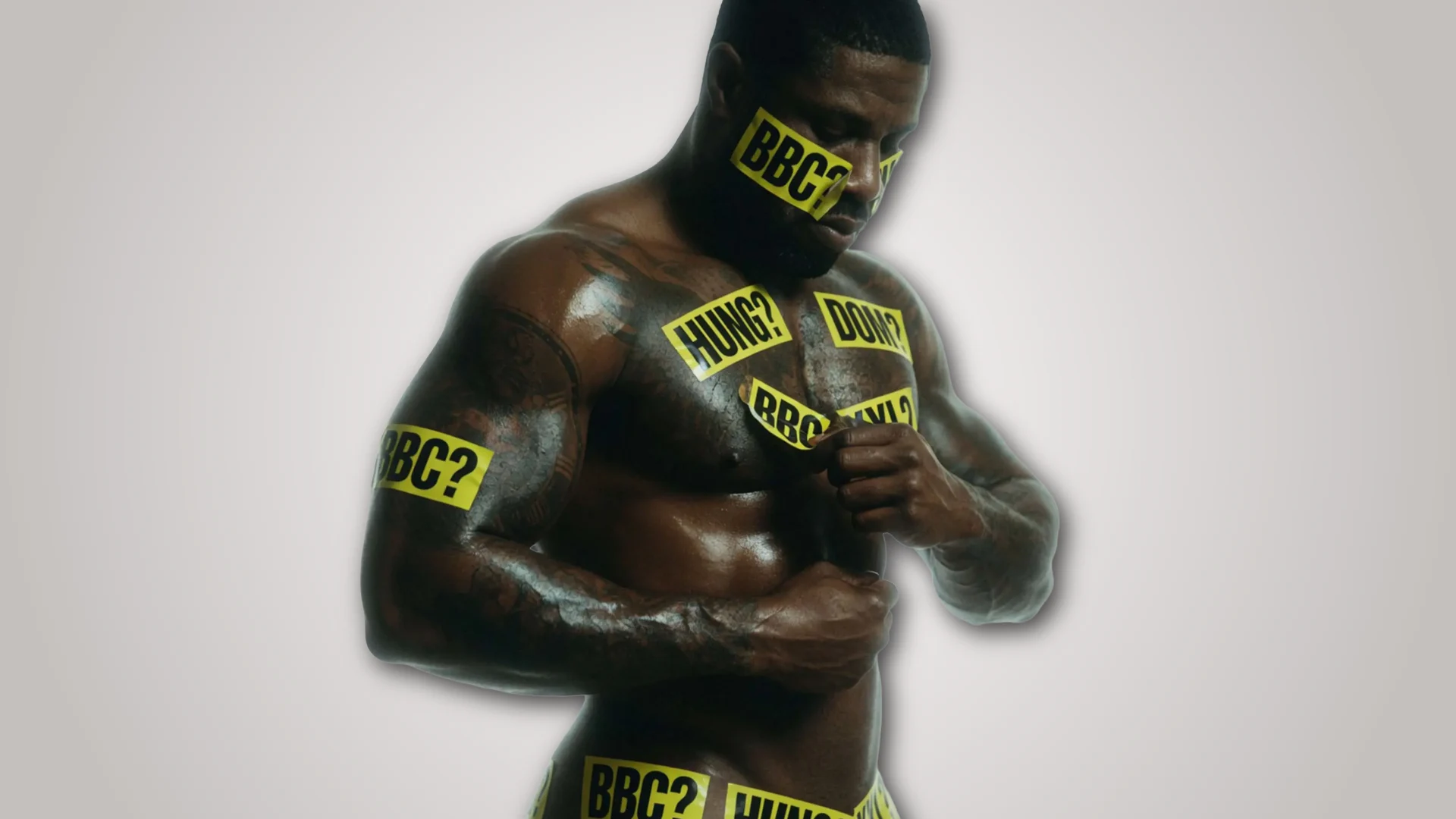
There is something quietly violent about being consumed before you are understood.
Not admired. Not even simply desired. Consumed.
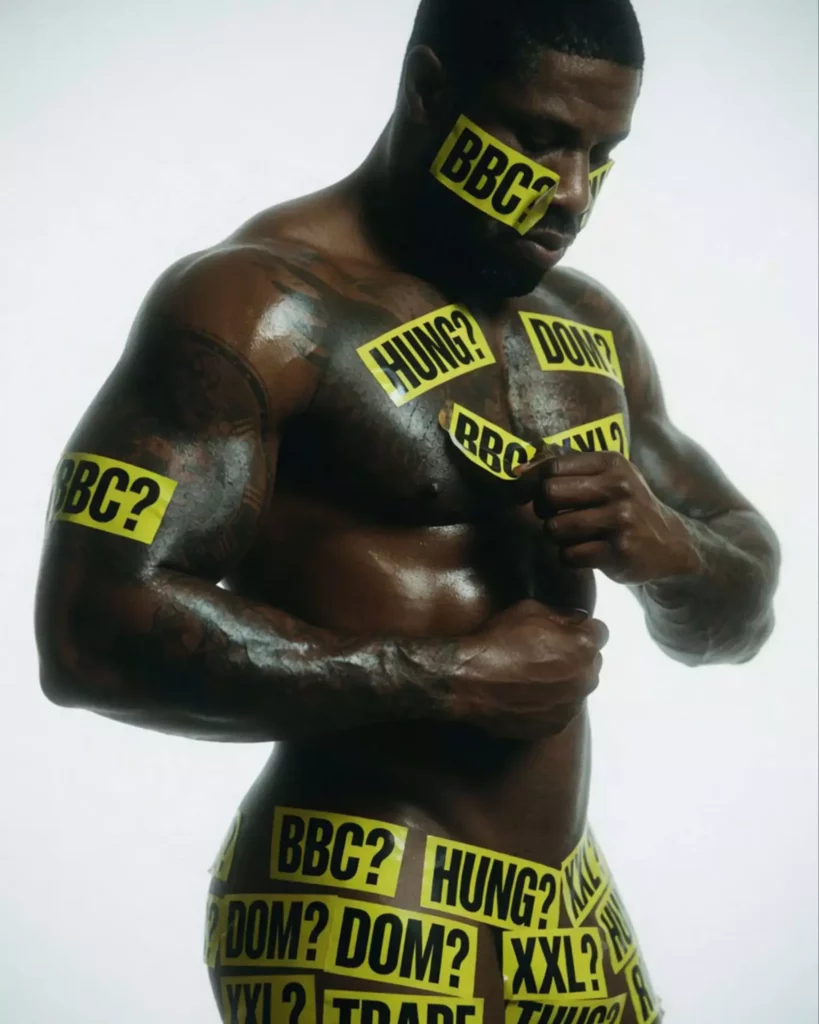
In James Rupapara’s photograph opposite, my body is covered in the words people often place on Black gay men before they have even met us: “BBC”, “hung”, “dom”, “trade”. They sit on the skin like price tags, like instructions, like something already decided.
That is what makes the image uncomfortable: it is not fantasy; it is evidence.
Because in gay spaces, especially when you are navigating race and masculinity, attraction is never neutral. It arrives with assumptions already attached. Before you speak, someone has decided your role. Before they know your softness, they have imagined your dominance. Before they ask your name properly, they have already placed your body inside a fantasy that was built without your consent.
The complicated lust for a Black gay man
And the complicated truth is that, at first, it feels like power.
When the world has made you feel invisible, being wanted feels like proof that you exist. You notice what gets attention. You notice what makes men reply faster. You notice what makes eyes change across a room. You notice the version of yourself that gets chosen.
So, you start feeding that version. You become a little colder than you are. A little harder. A little less emotionally available. A little more sexually confident than you actually feel. You learn when to play into the joke. You learn when to let the assumption pass because correcting it would ruin the moment. You learn how to be wanted without asking whether you are being met.
The fantasy of a stereotype
Many Black gay men know this conflict. We do not always say it plainly.
The message that starts with a stereotype instead of a hello. The flirtation that is less interested in your name than your body. The room where your race becomes part of the sexual atmosphere. The date where everything about you seems exciting until you begin being human.
Your tenderness becomes inconvenient. Your uncertainty becomes unattractive. Your need to be known becomes “too much”. So, you edit yourself. You leave certain parts outside the door. The softness. The fear. The awkwardness. The romantic part. The part that wants to be held without having to perform strength first. At some point, without deciding to, you stop showing up as yourself. You show up as something that works.
What it’s like being a Black gay man
This is the part people do not say out loud.
The same spaces that are meant to be freeing reward you for becoming a version of yourself that is easier to consume. The more you fit what people expect, the easier everything feels on the surface. More attention. More validation. Less friction. Momentum.
But something is off. You feel it afterwards. In the quiet. In that small gap between what just happened and how it actually felt. Like something happened, but nothing really touched you. Being wanted, but not met. Being chosen, but not known. Being seen, but not understood.
If it keeps happening, it stops feeling like an incident. It becomes a training. A way of moving through the world that keeps you visible, but not real.
Many of us learned how to survive as gay men before we learned how to live as ourselves. Survival teaches you what gets accepted. It does not teach you what is true. Survival teaches you how to become readable. It does not teach you how to become known. That is why the way out cannot be shame. It cannot be pretending desire does not matter. It cannot be becoming hard, bitter, unavailable, or above needing anyone.
Confronting desire
The way out begins with telling the truth to yourself.
When am I performing what people expect from me? When am I confusing being desired with being valued? When do I become less of myself because a smaller version of me gets more attention? When did I start calling consumption chemistry? From there, the return is possible.
You stop rewarding people who only know how to want you as a category. You stop treating disrespect as proof of attraction. You stop making your body audition for care. You let yourself be softer, even if softness does not get the fastest reply. You let yourself be complex, even if complexity makes you less convenient.
You understand that being Black and gay should not mean becoming someone else’s projection. It should not mean carrying other people’s fantasies as identity. It should not mean being desired in ways that slowly disconnect you from yourself.
The Gay Blueprint
There is another way to live. One where you can be wanted without being reduced. Powerful without performing. Sexual without being consumed. Visible without being used. Soft without apologising. Known without begging.
The tension between being seen and being understood is what I kept returning to while writing The Gay Blueprint. Not desire itself – desire is not the enemy – but what we start giving up in order to receive it.
Because being seen should not cost you who you are. And being wanted should never be the place where you disappear.
Andrew Akuruka is the author of The Gay Blueprint, a framework exploring identity, desire and how gay men move from survival into actual selfhood
This is a feature appearing in issue 371 of Attitude magazine, on sale in print and digital now. Order Attitude magazine issue 371 in print now, or in digital on the links below on Apple News+ and the Attitude app.