
Fashion mogul Adam Frisby on surrogacy, fatherhood and why UK law must change (EXCLUSIVE)
Speaking to Attitude, Frisby reflects on welcoming daughter Leven with fiancé Jamie Corbett, and why their journey inspired a campaign for surrogacy law reform
By Callum Wells
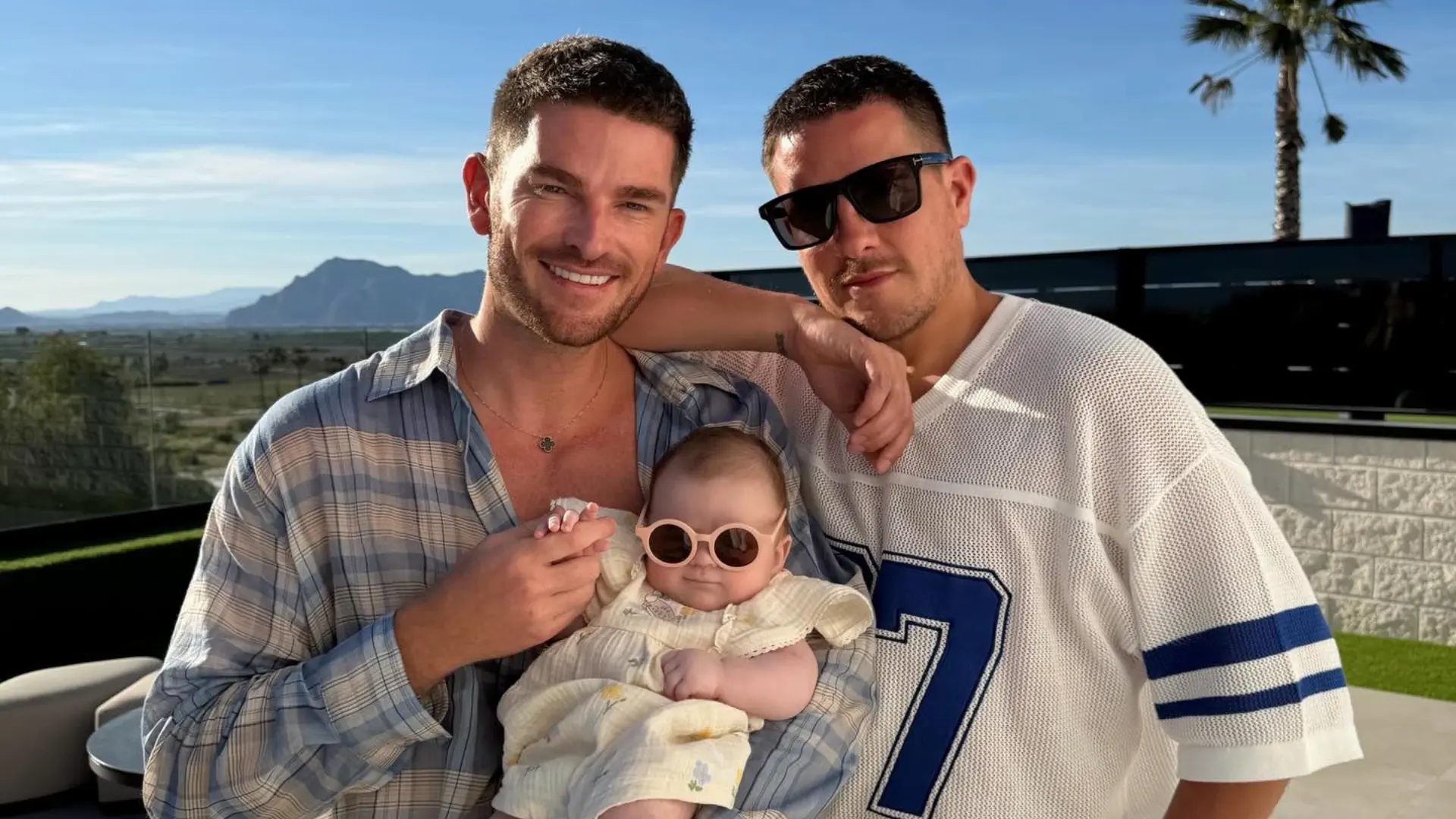
When Reasn co-founder Adam Frisby and his fiancé Jamie Corbett welcomed their daughter Leven via surrogacy in the US, they returned to Britain expecting to settle into life as new parents. Instead, they discovered UK law did not automatically recognise them as their daughter’s legal parents, forcing them into a lengthy parental order process involving courts and social worker assessments.
Their response sparked a national conversation. A petition calling for intended parents to be recognised from birth attracted more than 100,000 signatures in just days, securing consideration for a parliamentary debate on surrogacy law reform.
Speaking to Attitude, Frisby opens up about growing up believing fatherhood might never happen, the emotional toll of navigating an outdated legal system, and why he hopes his family’s fight will help ensure future LGBTQ+ parents never have to question whether the law sees them as a family.
A lot of LGBTQ+ people still grow up believing parenthood might not happen for them. Did you ever feel that way yourself?
Absolutely. Growing up, I don’t think I ever truly believed I’d become a dad. It wasn’t because I didn’t want children… I desperately did and it was something that always felt really heavy to me. But there just weren’t examples of families like ours, because when I was growing up it wasn’t even legal for same sex couples to become parents through surrogacy.
Thankfully, things have changed so much and now we get to wake up every single day to our beautiful little girl. But no one should grow up believing parenthood isn’t possible just because of who they love. I really hope that by seeing families like ours, younger LGBTQ+ people can grow up knowing that having a family is absolutely possible for them too.
Attitude: Was there a specific moment during the process where you realised the system urgently needed reform?
Adam Frisby: The minute I realised just how long and unfair the parental order process is for families like ours. In the US, we were recognised as Leven’s parents immediately, but the second we came home to the UK, legally we weren’t. Despite being our daughter’s parents in every possible way, the law still didn’t recognise us as her legal parents.
That just didn’t make sense to me and it was something we found really difficult to come to terms with mentally and emotionally. It was such a strange feeling and that’s when I realised just maybe we could make a change so families like ours in the future don’t have to go through this.
Your petition clearly struck a nerve very quickly. Were you surprised by how many people connected with your story?
Oh my god, completely! We hoped people would support it and I remember saying to Jamie, ‘If we can just hit 10,000 signatures, at least we’ll have started a conversation about it.’ But I never expected the response we got… over 100,000 signatures in just two days completely blew our minds and we were so grateful to everyone who got behind it.
What really stood out was how many people who had absolutely no connection to surrogacy still understood why it mattered. This was never just about our family… it was about making sure children born through surrogacy have legal security from day one, regardless of how they came into the world.
Emotionally, what does it feel like to be recognised as Leven’s parents in the US, but not automatically in the UK?
It’s incredibly difficult to explain because emotionally, nothing changes. She’s our daughter. We’ve loved her long before she was born. We brought her home, we get up with her every night and we do everything every parent does… But then to be told we’re not legally recognised as her parents and that we don’t have full parental responsibility until we’ve gone through a process that can take up to a year, is really hard to get your head around. It’s not been nice carrying that stress at a time when every family in this situation should simply be able to enjoy that special newborn bubble together.
It’s never been about validation because we know we’re her dads. It’s about making sure families like ours have the same legal security from day one as everyone else.
Do you think queer families are still treated as “alternative” by parts of society and the legal system in 2026?
I’d love to say we’ve come such a long way, but honestly I’m not sure that’s completely true. The amount of abuse we’ve received since announcing we were having a baby and particularly over the last couple of weeks following some truly awful events, has really shown me that homophobia still exists way more than I thought it did.
It often feels like we’re constantly having to justify or validate ourselves as parents and that just shouldn’t be the case. Don’t get me wrong…for every hateful comment, there are a hundred people who are unbelievably supportive of our family and I’m so grateful for that.
But I do think it’s sad that in 2026, same-sex families are still so often on the receiving end of negativity. Then when the legal system also doesn’t recognise you as your child’s legal parent from birth, it only reinforces that feeling that your family is somehow being treated differently. That’s exactly why we believe the law needs to catch up with the world we’re living in.
You’ve been very open about the court and assessment process. Did any part of it leave you feeling judged as two gay dads?
For us personally, we haven’t had the social worker visits or court hearing yet, so it’s hard for me to comment on that part of the process, although I’m sure it’ll all go smoothly. For us, it’s more the process itself that feels so outdated.
I do sometimes feel there are people who think we should be assessed simply because we’re two dads, which is just crazy to me because that doesn’t happen for heterosexual couples… and if anything, there are probably situations where it should.
That said, I do think it’s important to point out that this outdated law doesn’t just affect same-sex parents. It affects anyone building their family through surrogacy. That’s why this has never been about getting special treatment…it’s about creating a system that works better for every family and most importantly gives every child the same legal security from day one.
What’s the biggest misconception people still have about surrogacy?
Probably the biggest misconception we hear is that someone is just ‘giving you their baby’ …because that’s simply not how gestational surrogacy works.
Firstly, if intended parents like Jamie and I hadn’t created our embryos and planned to have a family, Leven would never have existed. Our surrogate carried our daughter, which is an incredibly selfless and amazing thing to do, but she isn’t biologically related to her. That’s a really important distinction that a lot of people don’t understand.
People also often ask why we chose to do surrogacy in the US and the simple answer is because the protections and the process are so much better. There is so much counselling, legal advice, medical screening and independent support involved before anyone even becomes a surrogate. Nothing is rushed, and nobody just decides overnight to do it.
These journeys are incredibly well thought through and are built around protecting everyone involved, especially the child. I think if more people understood what actually goes into ethical gestational surrogacy, there would be far fewer misconceptions.
You’ve also received homophobic abuse throughout this journey. Has that given you more motivation to carry on?
If anything, it’s reminded me why representation matters so much. Of course it’s upsetting at times, but I refuse to let hateful voices be louder than all the love we’ve received. For every horrible comment, there are hundreds of people showing kindness and support. If speaking up helps another family feel seen or gives someone hope for their future, then it’s worth it.
What would changing this law actually mean in practical terms for intended parents in the UK?
It would mean intended parents who have followed a fully regulated legal surrogacy process could be recognised as their child’s legal parents from birth, instead of waiting months for a parental order. That means less uncertainty, better legal protection for the child and families being treated as families from day one. That’s all we’re asking for.
If parliament does debate this issue, what’s your message to politicians who may still see surrogacy reform as a niche issue rather than a family issue?
Yeah, I do worry that because this isn’t seen as an issue that’s going to win votes or seats, it keeps getting pushed down the priority list. That’s frustrating because even the government has acknowledged that the current law isn’t fit for purpose.
I’d simply ask politicians to look beyond the word “surrogacy” and look at the children involved. This isn’t about politics or creating special treatment… it’s about making sure every child has legal certainty from the moment they’re born.
Families created through surrogacy might be a minority, but every child deserves the same protection under the lawand every intended parent deserves to have legal parental responsibility from birth. I don’t think that’s a controversial ask…I think it’s just the right thing to do.
Finally, if your daughter reads about this campaign one day, what do you hope she understands about why you fought so hard?
I hope she’s proud of everything we stood up for as a family… It was always about her and every other child born through surrogacy after her. We wanted to leave things a little bit better than we found them. If one day another family gets to bring their baby home without going through the legal uncertainty we did, then every difficult conversation, every interview and every challenge along the way will have been worth it. Most of all, I hope she grows up knowing she was loved so deeply that we would always fight for her.
Show your support by signing Frisby and Corbett’s parliamentary petition here.