
Remembering the gay hero who inspired Harvey Milk, orchestrated Stonewall and ‘invented’ Pride
Craig Rodwell is "absolute proof that the rights we have today, worldwide, are in significant part thanks to generations of queer booksellers," says A.J. West, author of How Queer Bookshops Changed the World, in this guest essay
By AJ West
Craig Rodwell was just 14 when he was arrested in 1954 for juvenile delinquency. Police had caught him hooking up with a 30-year-old man in a park in downtown Chicago, and it wasn’t his first rodeo. Rodwell had taken to skipping class and wandering the parks and streets looking for fun in the gay underground. It was dangerous and, to many modern readers, outrageous, but to Rodwell it was an escape from an unhappy life.
It was the 1950s – all shirts, side partings and kids dressed like their dads. Rodwell’s new stepdad was a bully and a homophobe and school was not his scene. It never had been. Aged six, his struggling but adoring mum had packed him off to a Christian Science facility for troubled boys, where he’d had his first romantic experiences, wandering out to the woods for a kiss with a classmate and holding hands in the lunch queue.
Teenage Rodwell was pretty, naïve and determined to kiss goodbye to his own innocence; he was risking his life and wellbeing with guys more than twice his age. Even then, without knowing his destiny, he was unflinchingly, indefatigably gay, but nobody could have guessed that this flirtatious, precocious boy would go on to change the world.
A new-found confidence
Leaving high school, Rodwell relocated to New York in 1959 with a ballet scholarship, moving to Greenwich Village where he’d heard rumours of a growing queer community. He was cruising Central Park late one night in 1961 when he found himself looking into the eyes of a 30-year-old man named Harvey Milk.
Milk was closeted then, unlike Rodwell, but they made each other laugh and quickly fell for each other. Rodwell was still only 20, impressed by his older boyfriend’s apartment and grown-up job on Wall Street. It was Rodwell’s first proper relationship, but they fell out less than a year later when he was caught sleeping around. Milk was growing uneasy with his gadabout partner.
Then, in 1962, Rodwell was arrested for resisting a police crackdown on inappropriate swimwear during a drag night at the popular gay cruising spot Jacob Riis Park. He was abused by a prison guard. Bruised and weeping, he sought comfort with Milk, who was horrified, breaking things off in case his rebellious boyfriend forced him out of the closet.
It seems Milk was haunted somewhat by this episode, and by his own discretion, going on to be a dauntless politician and campaigner for gay rights before being assassinated in 1978 in San Francisco. Friends from the time have acknowledged that it was Rodwell, his fearless young ex-lover, who helped inspire and shape his politics.
A need for a queer cultural space
It was the late 1960s and Rodwell was frustrated with the cowed and stuffy gay rights movement of the day. He envisioned a focal point for the lesbian and gay movement, a beating heart for the growing community, and a crucial literary resource offering information, inspiration and education. Many states were passing “sexual psychopath” laws at the time, putting homosexuals in the same category as rapists, paedophiles and sadomasochists, while psychiatrists were practising so-called conversion therapies including hormone treatments, lobotomies, electroshock ‘therapy’ and even castration.
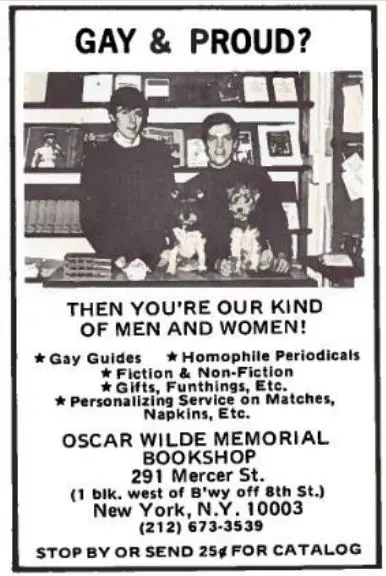
Rodwell wanted to create a tiny oasis amidst the cruelty and madness of the outside world and, against all odds and with very little money, he made it happen. The world’s first fully-fledged lesbian and gay bookshop was scheduled to open its doors in November 1967. Unlike the gay bars of the day, there would be no masked windows, no locked doors, no euphemistic name to conceal its identity. And unlike its grubby cousins, it would eschew pornography, stocking nothing but serious lesbian and gay books, and the shop would be run exclusively by lesbian and gay people. It would be a reflection of the owner, exhibiting a character of self-respect, dignity and untrammelled empowerment.
Funnily enough, it would also reflect the boarding school he attended. The Christian Science movement is known for having so-called “reading rooms” where people can sit, surrounded by the teachings peculiar to their faith. Rodwell took that model and inverted it, replacing “God” with “Gay”.
The Oscar Wilde Memorial Bookshop opens
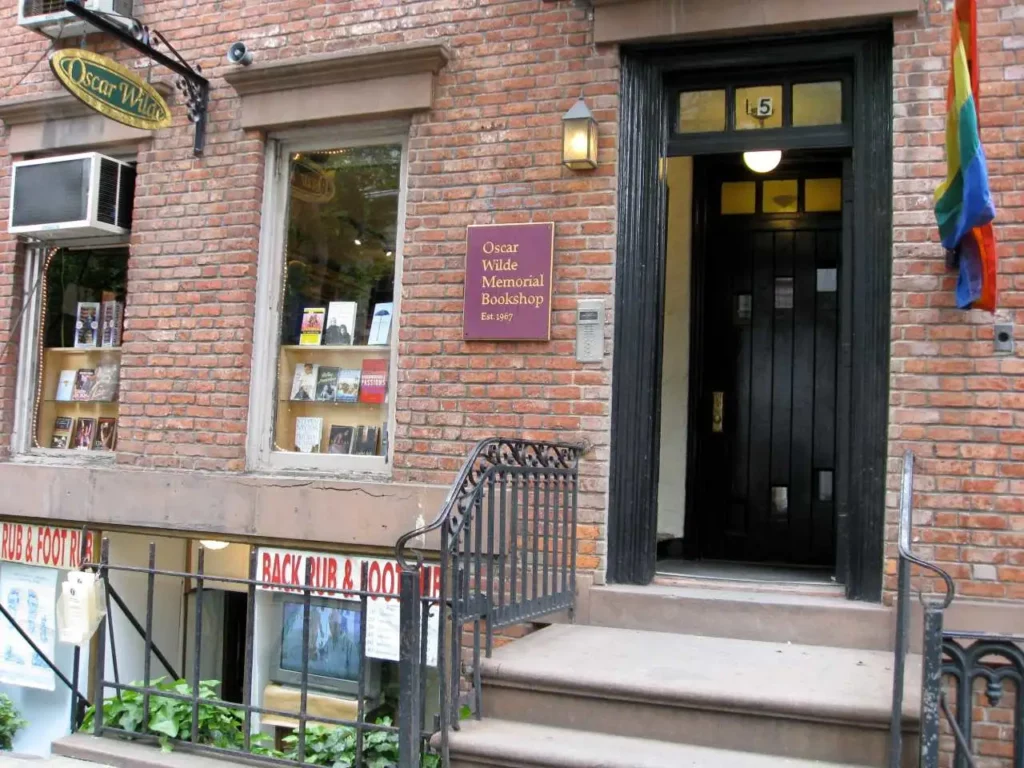
On 24 November 1967, the Oscar Wilde Memorial Bookshop opened for the first time in a small storefront at 291 Mercer Street, New York. His mum, now free of her bullying husband, had flown in to help put a precious 25 titles on the homemade shelves, assisted by a gay Schnauzer called Albert.
Word spread instantly; it was the talk of the town, the windows steamed up with the breath of customers and steam from coffee. Suddenly, New Yorkers could find gay liberation periodicals in one place alongside gay books and essays. Lesbians, meanwhile, could get the Daughters of Bilitis newsletter instead of searching for it in the underground. News travelled fast across the States then around the world. Tourists arrived by plane and sea – American soldiers fighting in Vietnam ordered books and subscriptions.
The shop was changing the way people saw each other and allowed radicals to organise campaign groups and political meetings in one place, ensconced in their own library of stories and essays. Something was in the air and, with the bookshop galvanising minds, the gay rights movement was about to rocket into popular consciousness.
A cry for “gay power!”
Eighteen months after opening, on Friday 28 June 1969, Rodwell followed sirens to the nearby Stonewall Inn. There was a police wagon outside while cops carried out a raid. This time, the patrons were fighting back. It was Rodwell who cried out: “Gay power!” as a lesbian woman was arrested and taken away. Two words which electrified the crowd on the night, and still run like lightning through our collective queer history.
Rodwell later said in an interview: “It was just everything coming together, one of those moments in history that if you were there, you knew this was what we’ve been waiting for.”
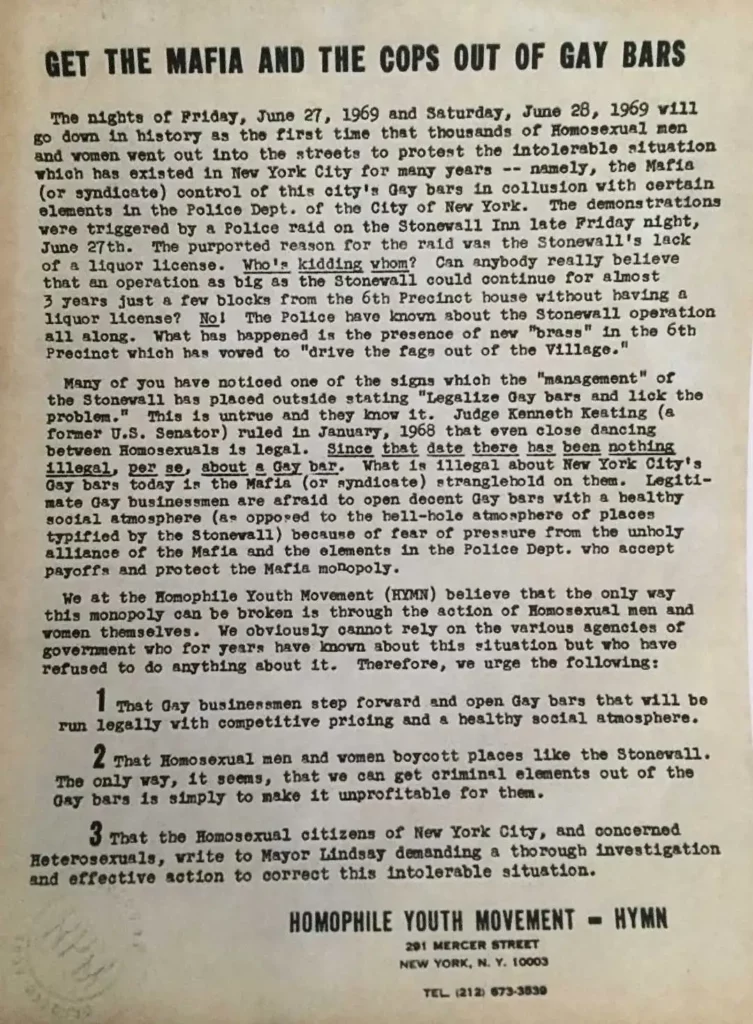
Rodwell ran to the nearest payphone and called the New York Times to tell them what was happening. Then it was Rodwell who stayed up all night furiously typing a flyer on the uprising, handing out five thousand copies the next day, titled: ‘GET THE MAFIA AND THE COPS OUT OF GAY BARS’. Those flyers inspired a second wave of riots that made Stonewall the legend it is today.
Christopher Street Liberation Day is born
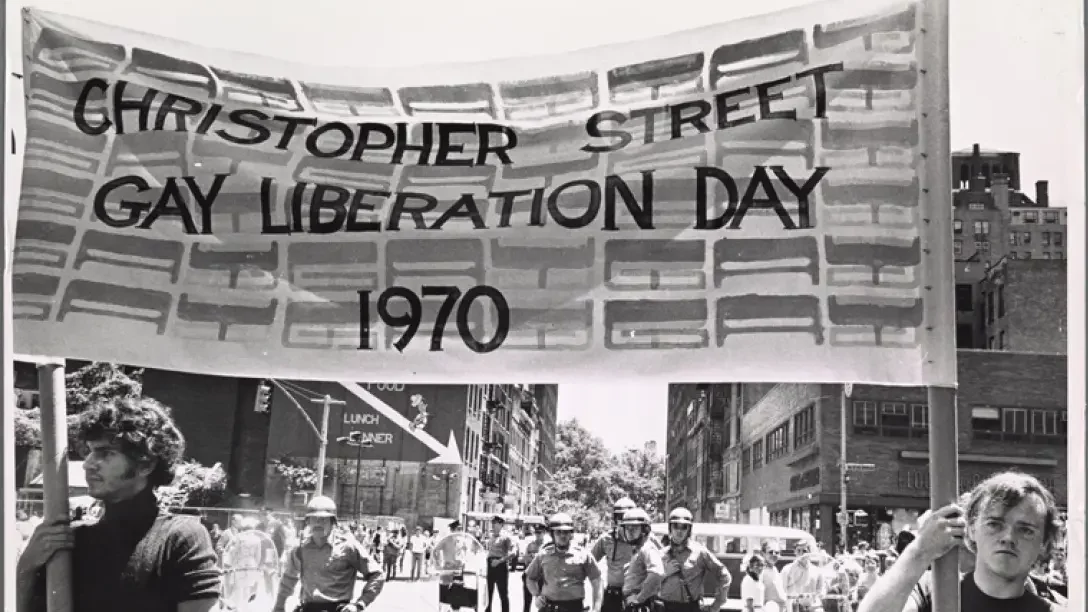
It could have been forgotten, lost to history as another bar brawl that didn’t ultimately change very much. But it was Rodwell who gathered his friends together when the uprising lost its heat and organised a demonstration for the last Saturday in June 1970. It would be called Christopher Street Liberation Day. No dress or age regulations, kissing and dancing allowed, even encouraged.
This was the world’s first Gay Pride march, planned in the safety of the Oscar Wilde Memorial Bookshop. An estimated 50,000 people came to march for their queer rights the following year.
Threats, backlash and resilience
Such influence comes with enemies. For the first time, queer people had their own bookshop, and right-wing bigots had a single, identifiable location on the map to focus their attacks. The Oscar Wilde Memorial Bookshop had swastikas daubed on the door and there were regular death threats to Rodwell and his staff. At one point, they had to employ security staff to protect them from intruders.
But the shop persevered and spawned many other queer shops across the United States and the world, not least Gay’s The Word in London, which changed the obscenity laws in the UK and still thrives on Marchmont Street today, a mecca to queer readers of all ages and identities. Sadly, the Oscar Wilde Memorial Bookshop proved less immune to the rise of chain bookshops and online behemoths.
A queer legacy that lives on
While Rodwell’s legacy lives on, the bookseller and his once-famous bookshop are lost to history. As a community, we didn’t fight hard enough to keep it. Rodwell died of stomach cancer in 1993 and the Oscar Wilde Memorial Bookshop closed after 16 years of struggle on 29 March 2009. Nonetheless, Rodwell’s spirit lives on in every queer bookshop still trading today, his spirit of freedom and unapologetic self-respect written into the DNA of all those that followed.
“While the past four and half years haven’t been financially spectacular for me,” he wrote all the way back in 1973, “the personal satisfaction and joy in seeing our people begin to stir and throw off the chains that have bound us for centuries is reward enough.”
He died knowing he had changed his world, and it is my intention to make sure all queer people celebrate and support their queer bookshops so we never have to lose another.
A.J. West is an author and award-winning journalist. His latest book How Queer Bookshops Changed the World is published by Oneworld Publications and is available now in hardback.