
Codpieces, jockstraps and boxers: how men’s underwear became fashion’s most intimate statement (EXCLUSIVE)
For centuries, underwear was designed not to be seen. Today, it's a cornerstone of personal style, body confidence and sexual expression. But how did we get from leather loincloths to Lycra trunks?
By Callum Wells
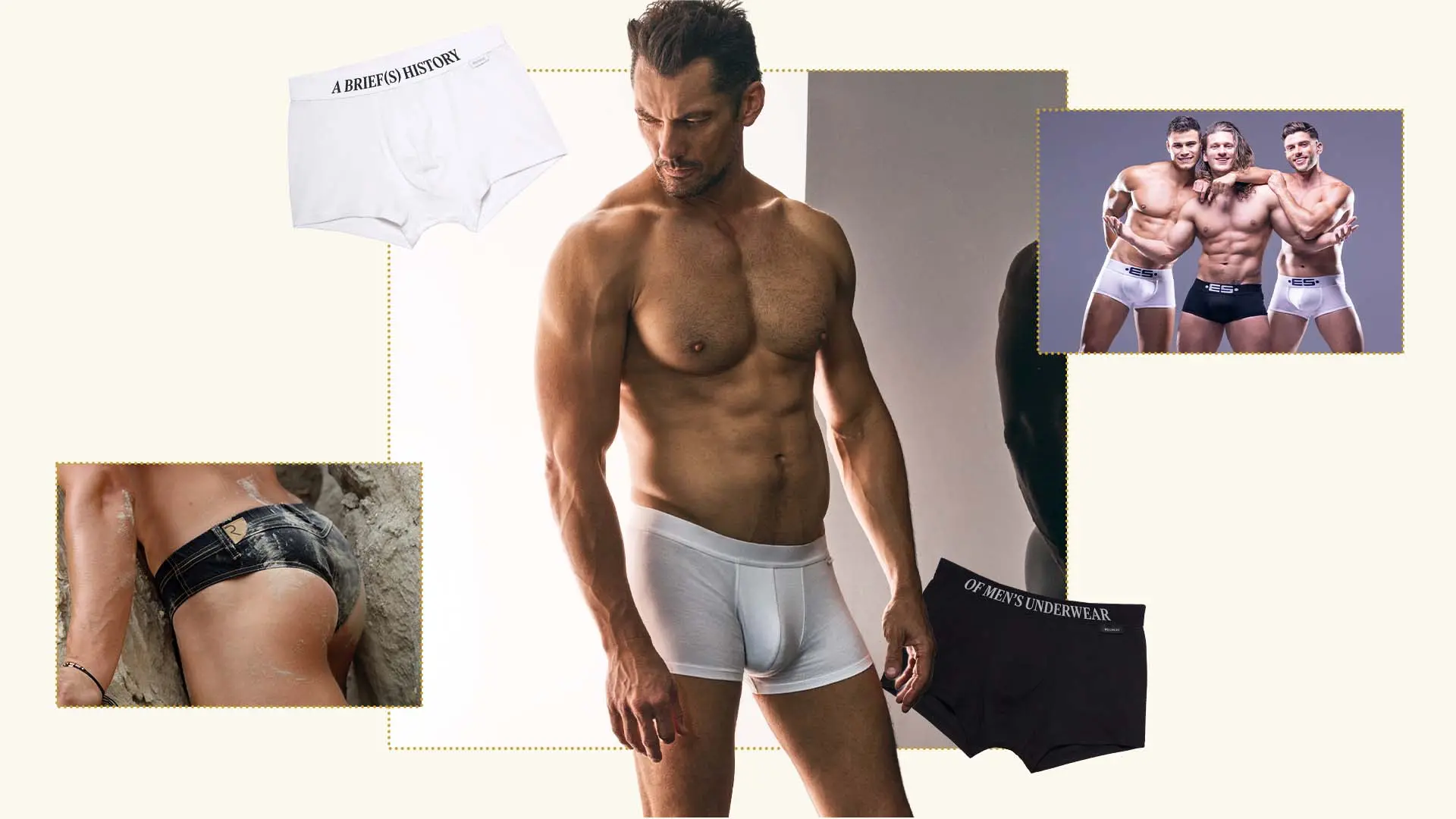
For most of human history, the purpose of men’s underwear was to remain unseen.
It was the barrier between an intimate area and the world, not to be spoken of, let alone seen or revealed to desiring eyes. Today, it does the opposite. It frames, flatters, supports and sometimes openly provokes. It has become the most intimate form of self-expression a man can choose – a quiet declaration that sits against the body all day and reveals everything about how he sees himself when the lights go out.
The journey from a simple leather scrap unearthed in a prehistoric grave to today’s nanotech-treated second-skin trunk is not a story of fabric alone. It is a story of masculinity itself: how men have decided what needs protecting, what deserves shaping, what can be hidden, and – finally – what is worth showing off.
Marta Franceschini, menswear historian and co-curator of the V&A’s 2022 exhibition Fashioning Masculinities, explains, “Underwear was born out of necessity, but it is also a signal of power.” Archaeological evidence takes us back roughly 7,000 years. The first coverings were loincloths fashioned from leather – the material our ancestors already knew how to work – which was later replaced by linen. When Howard Carter opened Tutankhamun’s tomb in 1922, he found 145 of the boy-king’s linen loincloths carefully folded among the treasures. “When you cover something,” notes Franceschini, “especially if it is the only thing you cover, you draw attention to that area of the body.”
Underwear on display
Medieval Europe took that tension and turned it into pure theatre. On the lower half, the standard underlayer were braies – loose, baggy trousers – but by the mid-16th century the codpiece had evolved from a functional triangular modesty panel into a heavily padded, sometimes bejewelled centrepiece of male display. “It started as reinforcement for the braies,” says Franceschini, “then became a declaration of virility.” The rise of horseback riding, full-plate armour and bifurcated outer garments demanded something more structured underneath. The spread of syphilis added a grimly practical layer – the codpiece could conceal medical bandages while still advertising potency. The classic portraits of Henry VIII capture the effect perfectly. Legs planted wide, the codpiece is the undeniable focal point of the entire composition. “In paintings, the pose itself directs the eye,” says Franceschini. “It grew exponentially because of the symbolic power it held.”
This was elite theatre, of course. Poorer men made do with simpler triangular patches of linen, wool, cotton, or sometimes leather, or a long shirt. Cleanliness itself was shaped by class, but not always in straightforward ways. Linen undergarments could be laundered, though doing so required significant labour, while leather items were harder to clean in the same way. Among elites, clothing was often changed less frequently, with hygiene managed through changing layers rather than regular washing. The link between hygiene and health only became well known in the 19th century.
A disappearing act
Non-Western traditions followed their own parallel underwear styles. The Japanese fundoshi and the Indian langot served similar protective and symbolic roles beneath draped garments, yet colonialism gradually imposed European norms. “The 19th century is a period of great colonial powers,” says Franceschini. “Western underwear became global through imposition.”
The 19th century itself slammed the door on medieval bravado. J.C. Flügel, writing in the 1930s, famously termed it the “great masculine renunciation”. After the French Revolution and the rise of industrial Britain, masculinity was redefined around work, restraint and public respectability. Colour drained from men’s clothing. Black, grey and blue became the uniform of the new middle class. Long drawers and one-piece union suits (like a onesie), made from cotton or flannel, disappeared beneath tailored outer layers. The long shirt was replaced by the vest or “health shirt” in wool or cotton, which promised to regulate body temperature and even ward off illness.
“Underwear really became underwear,” says Franceschini. It vanished so that the outer silhouette could speak of discipline and sobriety. Padding did not disappear; it simply went underground. Men padded their calves and chests to achieve the ideal silhouette. Satirical prints of the period mock the dandies who secretly shaped their bodies beneath their tailoring.
War brings change
Technology and sport tore the lid off Victorian repression. In 1897, American firm Bike Web Company patented and began mass-producing the first jockstrap. Another American company, BVD, pioneered lighter two-piece sets in the early 1900s, helping shift men away from bulky Victorian layers and towards something more breathable – although adoption was gradual, particularly outside the US.
The First World War accelerated this transformation through military standardisation and mass production of cotton jersey, embedding simpler, more practical underwear across both American and British wardrobes. What soldiers wore in the trenches increasingly shaped what civilians wore at home after demobilisation.
Yet change wasn’t immediate. During the Roaring 20s, British men’s underwear was still largely about utility, not allure, says Mitch Hughes, director of menswear at M&S. “Think heavy one-piece options, long-sleeved, long legs, and made from wool or cotton – sturdy, warm and anything but glamorous. We started to see a shift in the late 1920s – around the time we started to sell men’s underwear at M&S – when men moved to lighter separates including vests and shorts, signalling a move towards underwear that looked better, felt better and offered more than function.”
Founded in 1860, British brand Sunspel exemplifies this early 20th-century evolution. Owner Nicholas Brooke explains, “If you look back through the Sunspel archives, you can see a very clear shift taking place in the early 20th century away from the heavy, purely practical undergarments that men had worn in the Victorian era.” The brand’s cellular cotton fabric, developed in 1914 from fine Sea Island cotton, featured a honeycomb structure “that allows air to circulate while still keeping warmth close to the body… lighter, more breathable and far more comfortable” compared to bulky woollens or flannel.
Celebrity culture could undo centuries of habit. When Clark Gable appeared bare-chested in 1934’s It Happened One Night, vest sales plummeted as men suddenly saw no need for the extra layer. Marlon Brando reversed the trend in A Streetcar Named Desire in 1951, turning the white cotton vest into a symbol of raw, sexual masculinity. The popularity of the garment has ebbed and flowed ever since.
In 1935, the Y-front brief by American company Jockey – modelled on the jockstrap – was an immediate sensation in the US, and took off in the UK a few years later. Advertising, once unthinkable for something so intimate, had arrived. Post-1945, the pace quickened dramatically. The brief was shorter, more supportive, more revealing. Fabric innovation accelerated. Sports trickled into civilian life. Then, in 1947, Sunspel introduced boxer shorts to Britain, after the founder’s great-grandson John Hill discovered them while on honeymoon in America. Everlast had introduced elastic-waist boxer shorts, modelled on prizefighters’ trunks, two decades before, but they had only taken off after the Second World War.
Hill refined the design for a freer, more relaxed fit, adding a back panel for comfort, smoothing seams, and using the world’s finest cotton. “One of the most interesting things in the archive is that while men’s outer clothing in the 1940s and 1950s often appears quite formal and conservative, their underwear was sometimes surprisingly expressive,” says Brooke. “We have boxer shorts from the period in bold colours and lively patterns. It suggests a sense of individuality and even a little flamboyance in what they wore underneath.”
Fabric innovation accelerated: after elastic waistbands came Lycra in the 1960s and 70s for tighter silhouettes. “It was massive,” says Hughes of the 1990s shift to cotton/Lycra styles. “Suddenly, everyday men across Britain could wear underwear that moved with them, held its shape and looked modern.”
This is an excerpt from a feature appearing in Attitude’s May/June 2026 issue.