
UK surrogacy law put my family in legal limbo – it needs updating, urgently
Sanjay Sood-Smith calls for UK surrogacy law reform as he releases new book Who's The Real Dad? with surrogate Amber
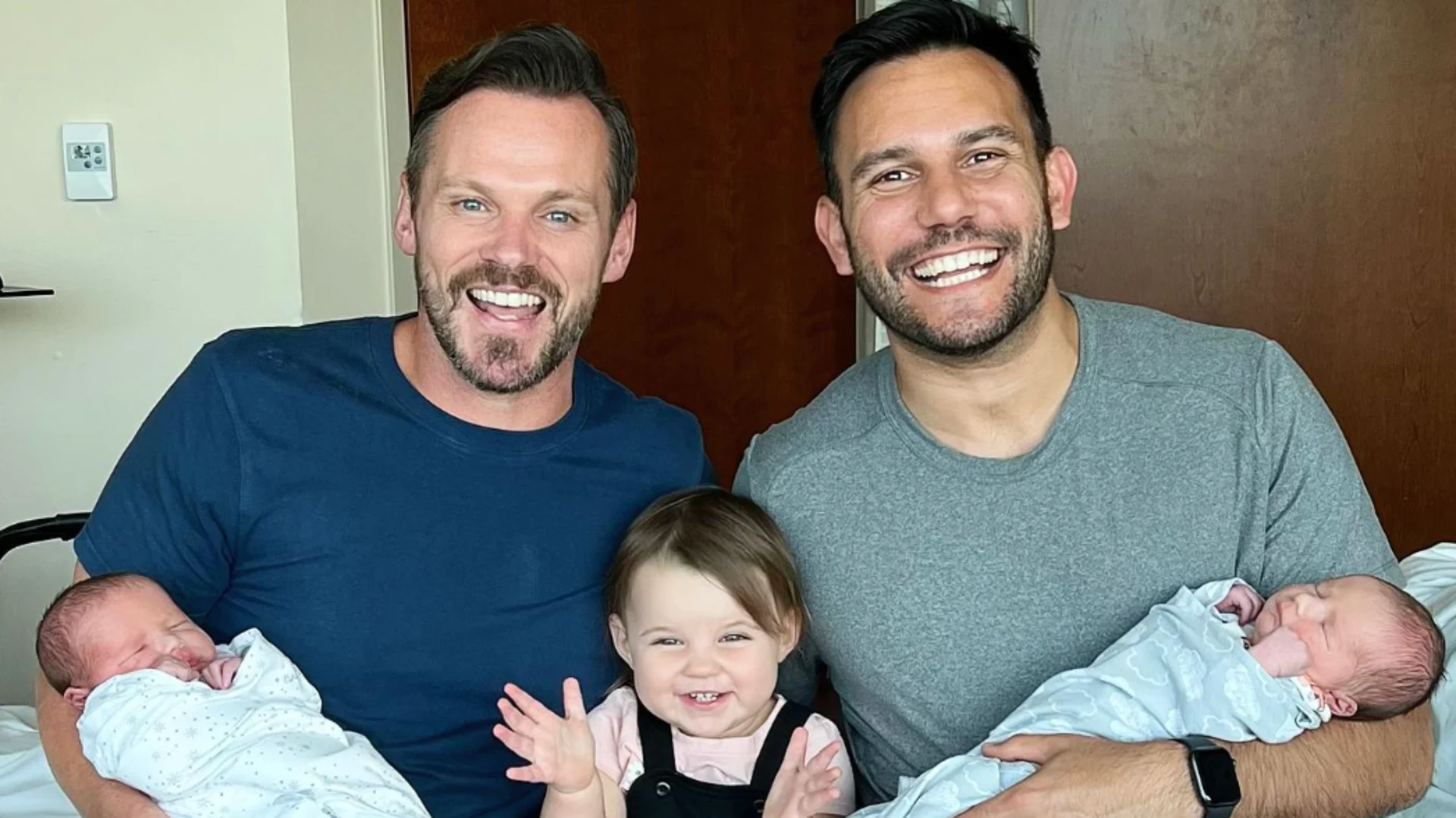
When our daughter Arya was a few months old, we took her to Paris for the weekend. Coming home, we very nearly weren’t allowed to bring her back with us.
You clear UK customs at Gare du Nord before you board the Eurostar, so we were standing on French soil in front of a UK Border Force officer when he asked whether Arya lived with us in the UK permanently. We said yes. He told us she couldn’t, because she wasn’t a citizen, and that we wouldn’t be allowed to board the train.
My husband and I are both British. We were both named on Arya’s US birth certificate, she had her American passport in my hand, and the only thing we were waiting on was her UK parental order. None of that mattered. We were pulled out of the queue and left standing in the middle of it, strangers watching, while the whole thing got escalated for half an hour that felt like a year. It was terrifying and humiliating in equal measure, and it was the one thing on a very long list of worries we’d never once thought to prepare for.
Why UK surrogacy law needs to change
The framework behind that moment was supposed to protect people. Standing in that queue, it was protecting nobody.
UK surrogacy law has barely moved since 1990. It treats the surrogate as the legal mother of the child, and if she’s married, it makes her husband the legal father. The intended parents, the people who planned this child, who’ll raise this child, who are often biologically related to this child, don’t count for anything in law until a court grants something called a parental order. That can take months. Sometimes more than a year.
We chose to have our children in the US precisely because the law there recognised us as their parents from the moment they were born. The trouble is that recognition stopped at the border. The day we came home, we were in legal limbo: parents in America, but not in Britain. For that entire time we had no legal standing to make decisions for our own child, so if one of our children had needed urgent medical treatment, the people legally entitled to consent were our surrogate and her husband, thousands of miles away, who never wanted or chose that responsibility. That isn’t unique to us. It’s the position every intended parent, and every surrogate, in this country is put in. It’s hard to describe how unsettling it is to raise a child the law doesn’t yet accept is yours.
The unexpected role of a surrogate
Which brings me to Amber. Amber carried all three of our children, and she co-wrote our book, Who’s The Real Dad?, with us. She became a surrogate because she believes, deeply and on principle, in helping families who otherwise couldn’t have children, and she was clear from the very start that our kids were never hers and that she never wanted them to be.
None of that changed how UK law saw it. As far as the law was concerned, the surrogate is the parent by default and the intended parents have no standing until a court says otherwise. So for months, Amber was on paper the legal mother of three children she’d never wanted to keep, while Doug and I, in the eyes of UK law, were no relation to our own kids.
I’m not saying there shouldn’t be a process, or that nobody should have to consent to anything. Of course a surrogate should be asked, formally and properly, whether she agrees. Of course there should be real safeguards for everyone involved, legal and emotional. The issue was never that Amber had to give her consent. The issue is that the law starts from the assumption that she’s the mother and we’re outsiders, and then makes a family wait the best part of a year to put that right, when it could just recognise intended parents from birth, the way they do in the country where our children were actually born. Amber didn’t want to be our children’s legal mother for a single day. We shouldn’t have had to wait months to be recognised as their dads. A sensible law could give us both of those things without losing a single protection.
Singled out because of surrogacy
Then there’s the social worker. As part of the parental order process, CAFCASS sends one round to assess whether the intended parents are fit to raise the child, so a few weeks into our children’s lives a stranger came to our home to decide whether we made the grade. The social workers who came were kind, the visits were gentle enough, and they saw exactly what was in front of them: a healthy, very loved child, and two dads who couldn’t believe their luck. But we sat through it knowing that no couple who conceives a baby themselves is ever asked to do the same, unless there’s a serious safeguarding concern. The only reason we were being assessed was the route we’d taken to have our family. As far as the system’s concerned, surrogacy is something to be checked, not a legitimate way to build a family. It felt wrong, because it is.
What makes all of this harder to take is that there’s no real disagreement about the need to fix it. Change was proposed and then kicked down the road, with the government deciding in the spring of 2025 that there wasn’t enough parliamentary time. A petition has since gathered enough signatures to be considered for debate.
An unsettling political change
But my biggest worry is the direction this country seems to be heading in. We’re living through a moment when LGBTQ+ rights are being chipped away rather than extended. You can feel it everywhere, from the rhetoric in our politics to the Reform UK councils that have started taking down Pride flags after wins in the local elections. The ground is unstable, with yet another change of leadership coming and the very real prospect of a much more right-wing government at the next election. It’s a mistake to assume the progress we’ve made only ever moves in one direction.
And the parental order, when it finally came, didn’t draw a line under any of it. Our children have British passports now, our names are on their birth certificates, and still it doesn’t stop. A couple of weeks ago, coming back into Gatwick as a family, the officer looked up at the four of us before he’d even opened our passports and asked, “Can I just ask what’s going on here? What’s the configuration?” It’s not a question any family with a mum and a dad gets asked.
And it isn’t only border officials. I’ve had to write to our GP surgery because every single time we took the kids in we were asked about their mum. The same has happened with schools and with strangers. Most people mean no harm at all. But society is still built around the idea that a child has a mother and a father, and when your family doesn’t fit that shape, you spend a huge amount of your life correcting people.
Battling never-ending stigma
Every time we’ve been visible about our family, we get a whole load of real hatred back the other way. People saying men like us should never have been allowed to have children. People reaching for the same tired tropes that have been thrown at gay men forever. All of it said openly and confidently in 2026. Russell T Davies caught the feeling of it exactly in his recent Channel 4 drama Tip Toe, in which he poses the question, ‘What happens when they see us, and they still don’t like us?’
I believe visibility is a political act, and I believe in it because I had so little of it growing up and needed it badly, and because my own kids deserve to see families like ours treated as completely ordinary. But visibility also puts you in front of the people who wish you weren’t there, and there are many more of them than we’d like to think. Even from where I live, in a fairly comfortable and progressive corner of London, my children will end up in classrooms next to kids whose parents say ugly things about families like ours over dinner.
Looking to the future
I grew up under Section 28, when the law made it all but impossible for a teacher to so much as admit that people like me existed, and I never believed I’d get to have a family of my own. That Doug and I now have three children is more than I ever let myself imagine as a boy, and I’m grateful for it every single day, and grateful to Amber in a way I’ll never be able to properly articulate. But being grateful isn’t the same as thinking the system is any good. It just means we got lucky. And the family that comes after us shouldn’t have to count on luck. They shouldn’t have to leave the country to be recognised as parents in it, or stand in a customs queue wondering whether they’re about to be separated from their child, or sit and be assessed like suspects, or keep explaining themselves to officials and teachers and doctors who treat them as a configuration rather than a family.
The water’s running in the wrong direction. The law isn’t fit for purpose and the government doesn’t seem to be in any rush to mend it. The hostility is louder than it’s been in years, and the safety a lot of us thought we had is turning out to be far less settled than we believed. The question now isn’t just how we hold on to what we’ve got. It’s how we keep moving forward, when the momentum hasn’t only slowed, but the pendulum has started swinging back against us.
Sanjay Sood-Smith is co-author of Who’s The Real Dad?, published on 2 July, a memoir written with his husband Doug and their surrogate Amber about building their family through surrogacy.