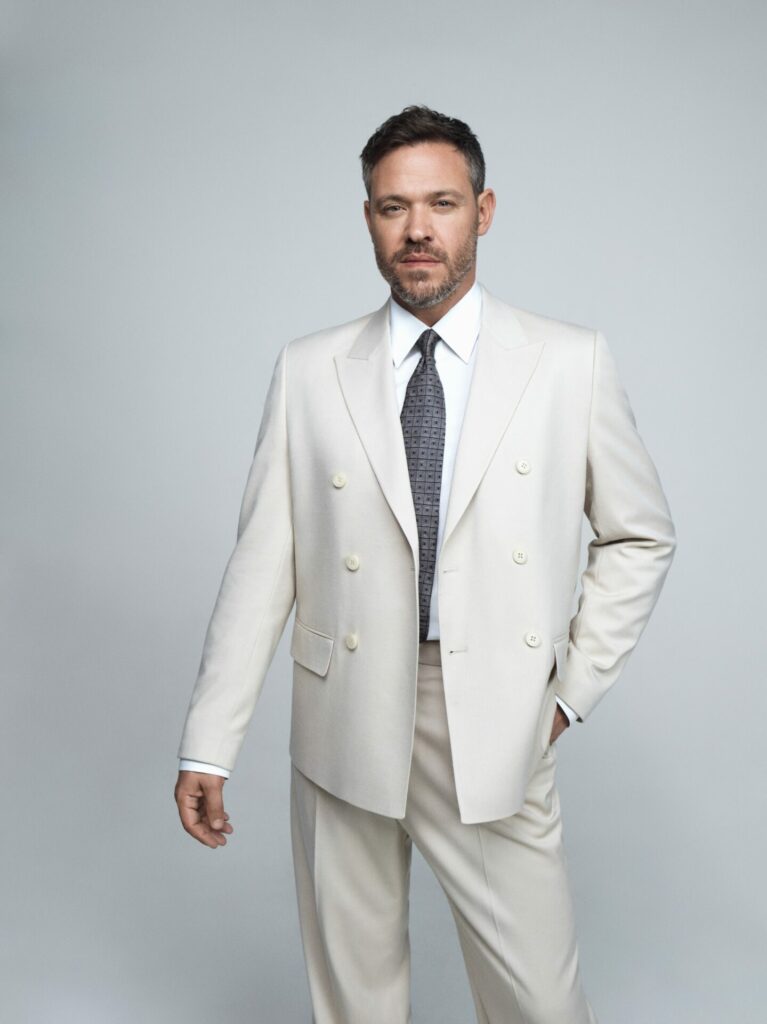
Will Young on 25 years in pop and gay and queer men’s mental health: ‘Few will walk into the fire of pain – but your essence is untouchable’
In this searingly honest interview, ‘Evergreen’ singer Will talks surviving showbiz (“they couldn’t buy me”), the office culture at 19 Management back in the day (“Victoria Beckham would walk through, beautifully turned out – I’d be hungover!”) his upcoming tour and what his “wonderful, amazing” boyfriend has taught him about love.
What’s a boy to do when, after waiting 25 years to thank Will Young for his role in your coming-out story, you experience a mental health crisis the morning of your in-person interview?
The answer: move it to Zoom and explain why. He’s a safe pair of hands for this sort of thing.
“How brilliant – you took agency, are still doing the interview, and you’re looking after yourself,” he says warmly, before later sharing: “I wasn’t sure if I would made today. When I woke up this morning, I felt awful. … I had a difficult week last week. I’m doing the best I can.”
The 47-year-old’s knack for soul-baring honesty, of course, extends beyond his polished repertoire (‘Leave Right Now’, ‘All Time Love’) and into everything he says and does. For our money, the Shout patron and former Wellbeing Lab podcaster is one of this country’s most prolific mental health advocates; missing out on the opportunity to have what was always going to be an illuminating conversation with him on the subject, through a gay and queer lens, was never an option.

Read on for a radically honest and inspiring interview that, to be clear, covers far more than just the psychological. Here, the Pop Idol winner reflects on 25 years of debut single ‘Evergreen’, the lesser-remembered Cathy Dennis-penned ‘Anything Is Possible’ (“a really s**t song, let’s be honest!”), standing up to Simon Cowell and rubbing shoulders with the Spice Girls and Annie Lennox. (“Simon Fuller’s wedding was fun!”)
This interview has been edited for length and clarity.
How does it feel to be celebrating 25 years of your career with The Evergreen 25th Anniversary Tour?
Amazing. What I didn’t realise, and it’s palpable, is when you’ve been around the block, which I have, you know when something exciting’s happening. The aim of the game is to carry on. I learned that a few years ago. At the Ivor Novellos, I ran into an artist – I’m not naming the artist, I can’t bear when people name drop – but the person was really excited to see me. I’d been doing it for about 10 years [by then]. I was like, ‘that’s interesting! This person’s excited to see me!’ Then I thought, ‘Oh God. I get it. Because I’ve been doing it for quite a long time.’ I realised, if you’re still doing it, you’re doing really well.
At 25 years, what I’ve noticed this week, is the reaction. Two things: people are loving 2000s pop at the moment. I’m very interested in that time. Then there’s nostalgia. Me coming from Pop Idol, this song, ‘Evergreen’, they just remember instantly where they were when I won. It creates connection.
That’s a cool thing. Someone came up to me and [said] their daughter was born to ‘Evergreen’. Now they’re coming to the tour with the daughter, who, of course, is 25! Which to me is like, so old! I can’t do the maths!
There’s something about the benefit of hindsight casting new light on a song like ‘Evergreen’. If I’m dipping into your discography, I’m not going to that song, I’m gonna go to the ones I love and know best. But now the song’s back in my consciousness, I remember all the words, the melody. I thought I’d forgotten, but I haven’t.
Same! You know, me and Simon Cowell were never similar people. But he did say something very smart, which was: you’ll always remember this moment, the winning moment, through this song. And so will everyone else. He was right.
It’s a Westlife song. It’s not the kind of song that I’d sang on the show. But it represents the moment. Sometimes that’s what songs do.
Are you looking forward to giving the comparatively underrated, Cathy Dennis-written ‘Anything Is Possible’ an airing?!
Oh! I shall not be singing that song, I’m afraid. I only ever sung it once, ever, on Top of the Pops. It’s such an un-Cathy Dennis song! It’s a really s**t song, let’s be honest! Which is so unlike Cathy. I don’t think she’d be offended… And if she is, that’s fine, she can have her feelings on it!
She’s written enough iconic songs that she’ll feel OK!
She wrote an amazing song with Burt Bacharach which probably most people don’t know. Never a single. A song for me on the first record. The most beautiful song: ‘What’s in Goodbye’. What a pairing, hello!
It’s amazing your albums have charted so consistently highly for so long. All the studio albums went top five, right?
I took it for granted. Looking at the charts now – seeing how things fluctuate for artists, which of course it does, it is what it is – is amazing. One thing I’m proud of – again, looking back, thinking nostalgically, because of the anniversary – is the choices I made in the people I worked with. I’m pleased I chose not to go on these writing camps.
I wrote with people like Nitin Sawhney, Lemon Jelly [Fred Deakin and Nick Franglen], Groove Armada. I wrote with Sia before she became a writer. I always loved her as an artist. That really stood me in good stead. Stephen Lipson, who produced Annie Lennox’s albums. I always made interesting choices and was supported through my management.
If I look at the different people I’ve worked with on the records, that makes my heart swell. […] I never really did the norm. It probably did make life more difficult. But I’m proud of doing that, particularly at a young age. That took guts.
It’s fascinating looking at an artist’s Spotify top 10. I always wonder what that’s like for the artist…
I don’t have Spotify, so I don’t know! I still buy CDs! Me and Elton John!
‘Leave Right Now’ is the most played, ahead of ‘Evergreen’, but ‘Switch It On’, my favourite, isn’t in the top 10! Which I can’t accept!
‘Switch It On’ was such a change for that record. An interesting record, actually. My difficult second album, even though it’s my third. Tricky to write.
I rewatched your famous interaction with Simon Cowell on Pop Idol. I was struck by how respectfully you disagreed with him and defended yourself. There’s a lesson in that, for how we conduct disagreements in the modern age.
Also, I felt at the time, even though that interaction wasn’t about your sexuality, empowered as a young gay kid, watching someone I sensed was gay stand up for themselves.
Oh, I love that. Thank you. I think I felt that. I think I did. Even though I wasn’t on the show talking about being gay, I knew other gay people would know I was gay. Come on, I’m singing Aretha Franklin! And wearing a tank top! I can’t make it more obvious. There is something about visibility in those times.
And there is something about taking a stance. I 100% agree with you on how we can communicate with people and disagree in a manner that’s respectful, not polarising. Also, you can act as a mirror for the other person.
The other thing about that was, it was standing up to power. Because of my background of being surrounded by power at an abusive boarding school, you know, I have a strong hyper-vigilance around that. I’m pleased I stood up to power. I wasn’t just standing up for myself; I was standing up for the other [contestants]. I felt very protective. That’s probably tied into my experience at school, feeling protective for the other kids. And probably the way I’ve been brought up, as well.
You studied politics at Exeter. I went to Exeter. Life gives you lessons that you don’t necessarily expect are going to come into play. You studied politics, it taught you how to speak for yourself, debate, think critically, whatever. Then that becomes relevant in this completely different context a few years later.
I was so used to having debates! I think, also, I was coming from a privileged place. In terms of, I’d gone into further education. A very good education. A very supportive family, who were affluent. All these things come into play when you stand up to people.
I’ll give you an example. When I won Pop Idol, they tried to give me a free car. I said, I don’t want it. The person couldn’t believe it. They were like, ‘but you can get a BMW’. I said, ‘my mum’s got a Porsche’. The reason I’m telling you is, I was very lucky. Because they didn’t know how to control me. They couldn’t buy me. It’s not like I was like Paris Hilton; we weren’t flying around on jets. But they couldn’t buy me. It wasn’t important to me. So, they couldn’t control me.
The week after I won, I walked into the office with a box file, and said, ‘Where’s my desk?’ They were like, ‘what do you mean?’ I said, ‘but you’re my management. I must have a desk.’ And then I asked them to go through the accounts!
I love it! I bet that rocked their world.
They absolutely freaked out. But again, it’s from a privileged position. I’m aware of the confidence I was given through the way I was brought up.
I can pinpoint the moment I started to accept myself and be proud of my sexuality: it was the day your News of the World cover came out, and my mother made a homophobic comment about it. That was the moment where I felt old enough and smart enough, and felt like I’d learned a valuable lesson in watching you, that I felt like I had the strength to decide, ‘no that’s BS. I don’t have to internalise that. She’s wrong.’
It’s amazing that you managed that.
You have a long history with Attitude. Do you remember the first issue you bought?
1997, Chris O’Dowd in his Batman and Robin outfit on the cover. I bought it in Tesco, shopping with my mum, because I wanted an example of a haircut. I didn’t know it was a gay magazine. I mean, something in me must have!
You also guest edited an issue for us in 2009.
I’m proud of that. Some interesting people.
You interviewed Victoria Beckham for us. Can you can do that again, please?!
I don’t think she’d have me because I slagged off her husband for taking money… [Laughs] Slagged of her husband for taking lots of money in a place where, you know… for the World Cup!
So did the whole community! We still love her!
It was very sweet of her to do the interview, because she did not know me, and I did not know her, really. I’d sung at one of David’s parties. She’d booked me. But we weren’t close, you know. But it was very kind of her to do it. Did I do Cheryl, as well? And Michael Sheen. Sam Taylor Johnson. Yeah, it was really cool.
I’m a massive Spice Girls fan. You guys shared a manager – any other memories of your interactions with them?
The Spiceys?! I always called the Spiceys. Loads! I don’t really have famous friends, but I am friends with Emma. I never felt comfortable in that world. You would be lost in it. But because of that, I would find it all very exciting.
Victoria would quite often come in. I would just be in the office, hungover, sitting on the floor, probably having just been out. That was hysterical. I remember one time her coming in, and she just sort of looked at me like: ‘What is this?!’ But also, I think I’d just sold, like, half a million albums!
I love how you describe it as just regular office culture!
But actually, it was! I’d come in, in my battered car, hungover on the floor. We used to have a bin, and someone called Fran that works at 19 Management would call it the ‘bit of truth’. I’d have to sit on it and say what I got up the night before. Then Victoria Beckham, beautifully turned out, would walk through.
I used to have a lot of fun with Emma actually, because we’d quite often go to Simon Fuller’s house in France at the same.
We used to get told off. They’d play a song and Simon would be like, ‘Emma, I love this song!’ and I’d say, ‘I think it’s s**t!’ She’d go, ‘no, no, no, we don’t like it!’ Simon would then ask me to leave early!
You know, they were always really generous. Melanie C, always lovely, Geri, always lovely. I don’t think I’ve ever actually met Mel B, funnily enough. Victoria, always very polite. It was fun. Simon Fuller’s wedding was fun. Most of the Spiceys were there. Annie and Dave. ‘What the fuck is this?! This is insane!’ He managed Annie Lennox as well.
It was a really good time. I did feel looked after, on the whole, by Fuller.
What has it been like for you, seeing the likes of Olly Alexander, Sam Smith, Troye Sivan and Lil Nas X rise through the ranks?
I’m friendly with Olly. I’m particularly fond of him. We did an acting job a while ago. He’s a sweetheart, so talented. I’ve interviewed Sam, I’ve interviewed Troye. I haven’t met Lil Nas.
How Sam has held themselves has been amazing. I can’t imagine that’s been easy, but maybe I’m putting that on them, I don’t know. I think we’ll look back on what they’ve been through over the last five years and learn a lot. It’s amazing. I don’t like using the word brave, as I think it’s patronising.
Grace.
Yeah. Again, it’s visibility, standing up. They’ve been doing what they want to do. That takes a lot of balls. Also, I recognise as an artist you should be able to do what you want to do.
I love Troye. It’s amazing to watch what he’s done visually; when you find the right choreographer.
The right team to bring out who he is and communicate it.
I know there’s been some criticism, perhaps. But he’s always been himself. He’s quite a tour de force, actually. But quietly so. It’s been interesting, watching his trajectory. When I interviewed him seven years ago, he wasn’t really what he is now. The videos are brilliant.
What do you think of Olly, Troye, Sam and Lil Nas?
It’s amazing. It feels like, with George Michael and Elton John before you, and then the new lot, it feels like you’re all drawing from the same well, you share an energy and a power. You are a family, and we’re a part of that family.
That’s lovely! We often forget Andy Bell and Jimmy Somerville.
And the Pet Shop Boys!
Yes. Because what Jimmy was doing was extraordinary. It often gets overlooked. Talk about visibility!
Harking back to your book, How to Be a Gay Man, do you have any new tips? Especially regarding mental health. I feel, anecdotally, there’s a bit of a crisis among men in this country today. I think a lot of queer men are struggling to love themselves and struggling to love each other.
I think you’re absolutely right. I think once you can recognise, perhaps, that a system of disconnection has been put on you from the very beginning, then maybe we can connect better.
I still feel that perhaps we connect under a patriarchal, heteronormative system. I think you’re right. Really, the bottom thing is to learn you’re absolutely lovable. And when this thing comes up to not connect with each other… I mean, I spoke to my partner the other day, and even then, he was saying, ‘I never really felt that I was like other people – or other gay men. Because gay men dress like this, or you need to look like this.’ I feel like that still goes on. One of the things for me is, ‘you need to be really outgoing; always the life and soul.’ I’d think, ‘God, I’m just not like that.’
I think it’s hard for gay and queer men to know that that essence is always there. You don’t have to be like anyone else. Just be you. To free yourself from those shackles, you must be vigilant and truthful with yourself. Really truthful. Because you might think, ‘yes, now I’m free, because I’m doing this.’ But are you? Are you really free? Have you really tapped into your true essence? If it still feels like, ‘if I’m like this, then I’ll fit in…’ Because a lot of it is about fitting in, isn’t it? It is complex in some ways, but in others it’s very simple, which is: recognise who you are. Your essence is untouchable.
You don’t have to tie into any norm at all. I used to go and see rugby matches. People would go, ‘oh, you’re here to look at the men’s bums!’ It really p****d me off. This is obviously when I’d come out. I always found it difficult. I was like, ‘I’m actually not.’ I used to play rugby. I can be gay and really like sports, cars and Kylie Minogue! You can be all these things. You don’t have to be ‘a type’. You’re not ‘masc’ or this or that – you’re just you. I don’t know what you think about that.
It’s really chiming. I’m trying hard at the moment to connect with another queer man in a loving sense. It’s hard. I don’t know why. It should be the most natural thing in the world, to just go for it when you feel good towards someone and they feel good towards you, but it’s been a nightmare my whole adult life! You’ve got a lovely relationship by the sounds of it…
I do. But can I just say, remove that ‘should’ from the equation. I’m really relating to what you’re saying. I’ve always found it difficult to be in a loving relationship. I didn’t really know how to do it. And to be honest, it’s terrifying to a part of me. Absolutely terrifying.
I think it’s really common in queer men.
I wonder if it is. I do. And I wonder if that’s why it’s easier to just go off and f**k someone. Because there’s no jeopardy with that. The reason I’m sharing it with you is, I have and do get very frustrated with myself. I’m like, what’s wrong with you? I do have the most wonderful, amazing, talented boyfriend ever! I wish I could talk more about him, because he’s kind of amazing. The stuff he’s done is amazing, and game-changing in his field.
But I do get shut down. My body goes into freeze. I don’t know what it is. I don’t know if it’s connecting as a gay man, if it’s still gay shame. I don’t know. I’ve done the explorations.
What I do know, what has never helped for me, is just hook ups and things like that. I don’t think that has ever helped. I don’t think I learned how to have loving connection. Maybe other people would say differently. But for me, I don’t think those things ever helped. Maybe I thought I was being more free. [But] learning that it’s safe to really love and be seen is absolutely terrifying.
I’ve taken a complete break from Grindr culture this year and I feel so much better for it.
Good. I think that’s brilliant. But what doesn’t help, and I’m saying this as a thank you, because it’s a lesson to myself… I get cross at myself. I could still, after two years, shut down a bit, freeze. I know I’m doing it. I get all, ‘what’s wrong with you?’
It’s just a reaction. You just have to be really kind.
… The thing around relationships, I just can’t tell you how much I relate to it. I can’t tell you. It really frustrates me. I get so cross with myself. So, you’ve really helped me today. Because you’ve allowed me to see that I need a bit more grace.
So many people sadly go through life without questioning or attempting to overcome or learning to understand these behaviours. It can ruin lives. But with the right research, support, and the strength and will, you can learn to live and be happy.
You can. Who wants to walk into the fire of pain? I mean, that’s just not the human condition. Very few people will walk into the fire of pain. It’s much easier to go, ‘you know what, it’ll all be fine.’ For me, it was like, ‘it’ll be fine if I just get that car, or more of a six pack, or if I start feeling more comfortable dancing with my top off.’ These things, whatever it is, they’re ultimately distractions from the pain. But who wants to go towards the pain? No one. Even your body doesn’t want to go towards it.
I’m always fascinated to ask anyone who’s been so open about their experiences as you have, who is such an advocate on the subject [navigating mental health] – what specific, personal tools have you developed for yourself?
What helps me is to not take any of the messaging in my body, or the thoughts in my brain, personally. Someone said to me the other day, ‘don’t even get involved in it.’
They were like, ‘why are you taking it so personally? It’s just an old mechanism.’
It’s not so much a tool as an overall place to come from. Which… I’m trying. Still trying, by the way. I had a really difficult week last week. I’m doing the best I can. I wasn’t sure if I would made today. When I woke up this morning, I felt awful.
But what I’m working with, is that there is the me who’s always fine – and of all of us, we’re all fine. Then the sensations or thoughts are distractions.
Yeah.
That’s not to negate emotions. But when I can tune into and centre – this would be my tool – that there is a part of me, my true me – Buddhists would say, the observer – it’s always fine. They’ll always be fine, until they’re no longer fine, which means that I’ve died.
I think people would call it consciousness. The more you can tap into that… It feels so unnatural to tap into it, because, if you’ve been attached to fight and flight and freeze, hypervigilance, growing up queer, just in your DNA… If you can unattach from that, and know that the true you is always fine, and come at life from that place – the more you do it, the more I do it, it’s the ultimate gamechanger.
It’s like, ‘oh, I was fine all along.’ But it’s so hard to tune into that. Because growing up queer, you’ve collapsed your identity into ‘I’m not safe’. But when you realise you’re always going to be safe, it’s a gamechanger.
Will Young’s The Evergreen 25th Anniversary Tour kicks off in February and March 2027. Tickets on sale here: willyoung.co.uk
Evergreen Anniversary Tour: new dates
Monday 15 March 2027 – Ipswich – Regent Theatre
Tuesday 16 March 2027 – London – London Palladium
Thursday 18 March – Manchester – O2 Apollo