
Russell T Davies: ‘Maybe it’s time for me to write my big gay love story’ (EXCLUSIVE)
Russell T Davies speaks to Attitude about his new memoir, which charts his journey as a writer from Queer As Folk to Doctor Who and beyond
By James Hodge
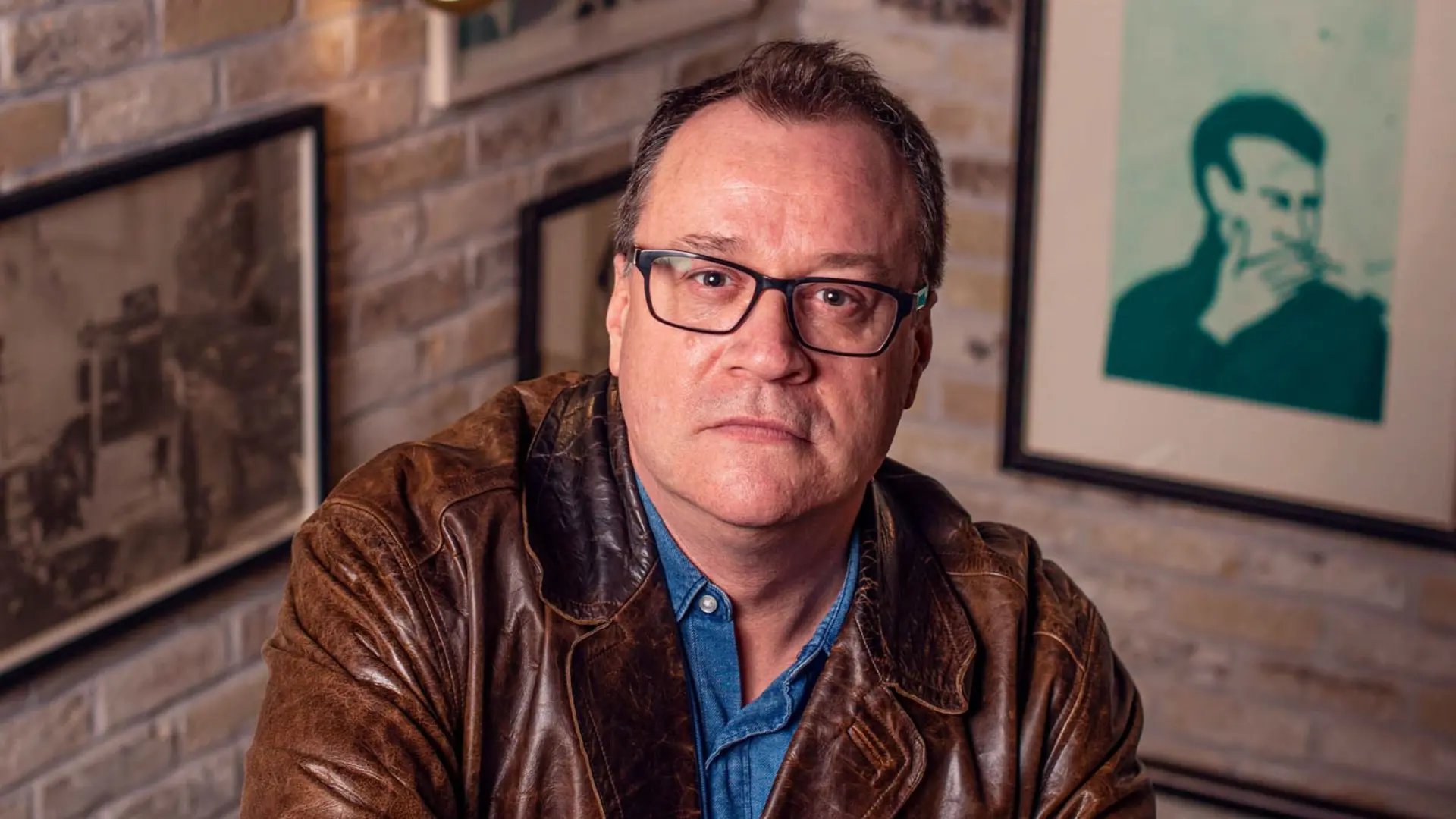
Arguably the forefather of LGBTQ+ television, Russell T Davies has written and developed many of the most iconic queer TV series of all time. From groundbreaking drama Queer as Folk in 1999, to his 2015 triad of interlinked shows, Cucumber, Banana and Tofu, his portrayals of queer life are some of the most celebrated in queer televisual history. He is also considered the king of science fiction, acting as showrunner for the Doctor Who reboot who brought everyone’s favourite Time Lord back into the mainstream. In recent years, his work has become more political and angry: 2019’s dystopian Years and Years foretold the rise of the far right, and his recent hit Tip Toe explores a possibly dark future for queer people.
In his newly released memoir, The Queerest of Folk: A Life in Television, Davies shares insights into his career in the media industry, from his humble beginnings in children’s programming through to his mighty rise to one of the most beloved and respected writers and TV makers in the UK.
Here, Attitude speaks to Davies about what it is like to look back on a lifetime of work, how the loss of his husband shaped him as a writer, and the struggles of queer storytelling.
Attitude: This is an unusual memoir because it focuses on the process of creating your incredible body of work.
Russell T Davies: I wanted to illustrate my writing life in motion. When I’m interviewed about the TV shows I have made, I say “I made Tip Toe this way because I wanted to explore…” or “I made Queer as Folk in order to…” but actually, the reality when I truly look back is “It was midnight on a Wednesday and this actor pulled out and I had to make a deadline on this budget.” This book explores the blood and guts and steam and smoke of the [TV] production: what it’s like to work on a project rather than just reflecting on the end result. I hope it’s a book that reveals the realities of the job behind the scenes and works for people who want to write or produce or direct.
What made you want to write it at this point in your career?
Well, I was asked to by a marvellous man who I met at a key point in my career: Boyd Hilton. He was at the very first press launch of Queer as Folk, which was a fire pit. We innocently walked out of the screening into a roomful of 200 journalists who were all out for blood. Straight journalists from the Mail who were out to get us; gay journalists furious that we’d portrayed gay life to be full of drugs and sex and promiscuity. Boyd was the one journalist in the room calm and smiling and happy. “I’m from a brand-new magazine called Heat,” he told me, “and our readers are going to love it!” He was the one friendly face in the room, and we have been great friends ever since. When he came to me suggesting I write about my career, it felt like the time was right. I’d written Tip Toe – the angriest I’ve ever been as a writer – and it felt like a moment to pause, decompress and look back.
There is an incredible prescience in your writing. It’s like you can predict the future through your storytelling. Where does this ability come from?
The truth is, I’m the man who gets to write about the future. I think many of us sit in pubs with friends, at home with families or in bed with our lovers discussing the world. We can all see what’s coming and we talk about the future all the time. But I put it on the page! I struck lucky with Years and Years: I predicted the invasion of Ukraine; I predicted a global pandemic. The reason I capture the future is because I’m the outlier in that I write about the future. To be honest, I throw an awful lot of predictions at the wall and about 50 per centsticks – a lot of my stories never come true!
Did you revisit each of your previous works before you wrote the book?
I’m very lucky because I am often invited to rewatch my work at film and TV festivals. In Manchester, I’ve had the pleasure of attending the Scene Film Festival who have been screening retrospectives of my work for the past three years. I get to revisit my shows on quite a regular basis, and it is interesting. They change every time I see them. Sometimes it’s to do with the craft: I see something about the process; I see what I was trying to do in a moment; I remember a memory that I’d forgotten. Sometimes it’s thematic: a change of perspective on an idea I once had or a realisation that problems that were affecting people in 1999 are emerging as problems again in 2026 – or never went away.
And when it came to the writing?
It started as a series of interviews, but I was aware that interviews can be dangerous. There’s a danger when you have spoken a million times to journalists about Doctor Who that you’re turning every reality into an anecdote and adding funny flourishes to every ending. You exaggerate or shape things. Everyone does that with every story we ever tell. We heighten. I wanted to chip away the decoration and remember what things were really like: to lose the gloss of anecdotes that have lived at the surface and get back to what the process really felt like at the time.
I do want to add, however, that the birth of this book doesn’t mark the end of my writing. I’m going to keep my writing!
When you were looking back, was there anything about your work that surprised you?
Whilst the viewer comes to my work cold, I actually sit at my desk with every single show in my head every day, and I think about them all the time, so it’s hard to be surprised by them in a way. But every time I watch episode one of Queer as Folk, I’m still shocked by quite how absolutely radical it is. I’m surprised at myself because I’m not a particularly radical person. I’ve had a lovely life living in Manchester. But the Manchester of Queer as Folk is blazing;it’s on fire. The language is filthy; I didn’t try to keep anyone happy or pander to the crowd. I genuinely look back and think ‘Oh my God, where did I get that nerve from?’ You’d expect that it would look dated by now. The fashion is, probably. But actually, at its heart, it’s as cheeky now as it was then.
One hugely poignant section of your memoir explores the death of your partner, Andrew.
Andrew is utterly bound up in my work. His illness literally brought my writing to a temporary halt. When he was diagnosed with cancer, I stopped work. I am so glad that I chose to stop and spend that time with him. Eight years later, when he was dying, I was in the middle of work, making Years and Years, and still hadn’t written the last episode. He is a big part of my own story, and his story lives on in this book too. And in my work. I was very aware of his passing when I was writing Colin’s death in It’s a Sin. There are actually moments of Andrew’s physical condition that I echoed in Colin, with his eyes staying open, unseeing but still conscious.
Did his passing change you as a writer?
Undoubtedly. Everything that happens in a writer’s life changes the writer, whether bad or good. But I do want to highlight: you don’t need to have experienced trauma and tragedy to become a writer. Andrew’s passing of course permeates moments of my work. However, there’s a saying I always cling to with writing: that a moment’s imagination is worth a lifetime’s experience. Sometimes you can feel intimidated as a writer if you are young and lucky to write drama: you might feel you haven’t suffered enough. Firstly, you can imagine whatever you want. Secondly, don’t tell me you haven’t suffered, because everyone, every single person in the entire world, has fallen in love with someone who doesn’t love them. Everyone. You don’t have to have been poverty-stricken, you don’t have to have terrible loss or trauma in your life, and you can mine your own experiences and imagine other experiences then. Nonetheless, yes, life itself enriches you. People share their sadness all the time from which you can mine inspiration: just keep your eyes and ears open.
While you have, I would argue, done so much for the queer community in the world of TV, the book notes that you have often had backlash from the community too…
We are a community that is used as a football for politics. We are kicked about and used, and speeches are made about us all the time. That leads to us having our own debates. That’s not a bad thing. This keeps us young and keeps us lively. We are a part of the debate. There’s never a day when we’re not important. There’s never a day when our rights aren’t being discussed. There’s never a day when we’re not in danger, to be honest. And as much as I might wish it was otherwise, nonetheless, that keeps us on our toes. It keeps the clever people among us on guard. And it means speeches must be made. It means positions must be taken. It means you must commit to the cause. And I like that I commit to my beliefs. With debates about queer actors playing queer roles, and what should be represented and what shouldn’t, we grow up as a community.
The thing is, we’re still very young as a community. We lived in secret for thousands of years and then the laws pass in the 60s, 70s and 80s and we become public. What a new society we are. We’re still discovering. We’re not just waiting for straight people to discover us; we’re waiting for ourselves to discover ourselves. And sometimes we fall into the trap of thinking that the battle concludes with a perfect society. There’s no such thing. There’s never been a perfect society in the history of the world. Straight people have known that for a very long time. Their civilisations rise and fall, and there are good times and there are bad times. It’s never perfect. So we’re now in that cycle of realising, I think, that we won’t ever have perfection. We will never all agree, and that’s OK.
Do you feel like life in the TV industry has improved for queer people?
Without a doubt. I say at the beginning of the book how lucky I am – there is almost no criticism of anyone in the book because I didn’t want to write a bitchy book. I didn’t want to attack people: I have to be professional. But also, as a general rule, television drama is full of left-leaning liberal people, and they’re people who are interested in telling stories about the human heart. By their very nature they tend to be nice people. There was a time, of course, when people weren’t interested in my scripts because they thought my stories were too gay, but I stood my ground, waited and proved them wrong. It never worried me for a second.
What’s striking in your memoir is that you are hugely warm and optimistic, but you can really stand your ground when you need to. Where does that come from?
It’s my job to stand up as a queer person. It isn’t the actor’s job to stand up for gay rights whether they are gay or straight. They are there to act. As a bit of a gay pundit, I have toknow my stuff. Over time I found that I had to step forward: I had to get involved in the conversation. And then, I am a wordsmith, so I’m quite good at speaking up for people. It’s my job to rise to the moment.
Why do you think Doctor Who has continued to mean so much to queer people?
Science fiction is interesting to queer people. It’s the camp of it: funny hats and green laser beams. And then it’s the escapism. There’s something about the gay sensibility that seeks out fantasy shows, full stop.
Do you think a young Russell T Davies would ever have imagined the myriad queer stories being told on television today?
It simply wasn’t imaginable. I always thought for many years that our community would be kept on the outside in a quiet niche. And it did take a long time, but then there was a sudden rush: fantastic lesbian stories in Bad Girls, a kiss on EastEnders. But it took the passing of a whole generation before it’s become part of the everyday: Heated Rivalry, Heartstopper, Big Boys. We are lucky to live in a world with so many big imaginative geniuses. They’re always there, in every corner of the world, in every society, in every civilisation. Great gay brains, great queer imaginations will sit and think, and they don’t care what the rules are, they don’tcare what the restrictions are, they don’t care who their enemies are. They sit and they write and they paint and they sing and they create, and they always succeed.
And happily, years later, you have found love again with your partner Oliver. Do you think this love will reshape your storytelling once again?
I’m very lucky. I truly never saw this happening to me again. Oliver certainly gives me a younger perspective. I realise now that young people don’t watch films, they just watch clips. You say to Oliver, “Have you seen this film?” “No, but I’ve seen the clips!” He’s given me a brand-new perspective and sees the world through different eyes. And of course, we do talk about Andrew a lot. He’s not gone, he’s not forgotten, he’s part of this relationship as well. Maybe it’s time for me to write my big gay love story…
The Queerest of Folk: A Life in Television, published by Penguin, is available to buy now.