
Pet Shop Boys reflect on an astonishing discography: ‘History is looking back; legacy is looking forward’ (EXCLUSIVE)
This is an excerpt of a feature appearing in Attitude’s November/December 2026 issue
By Nick Levine
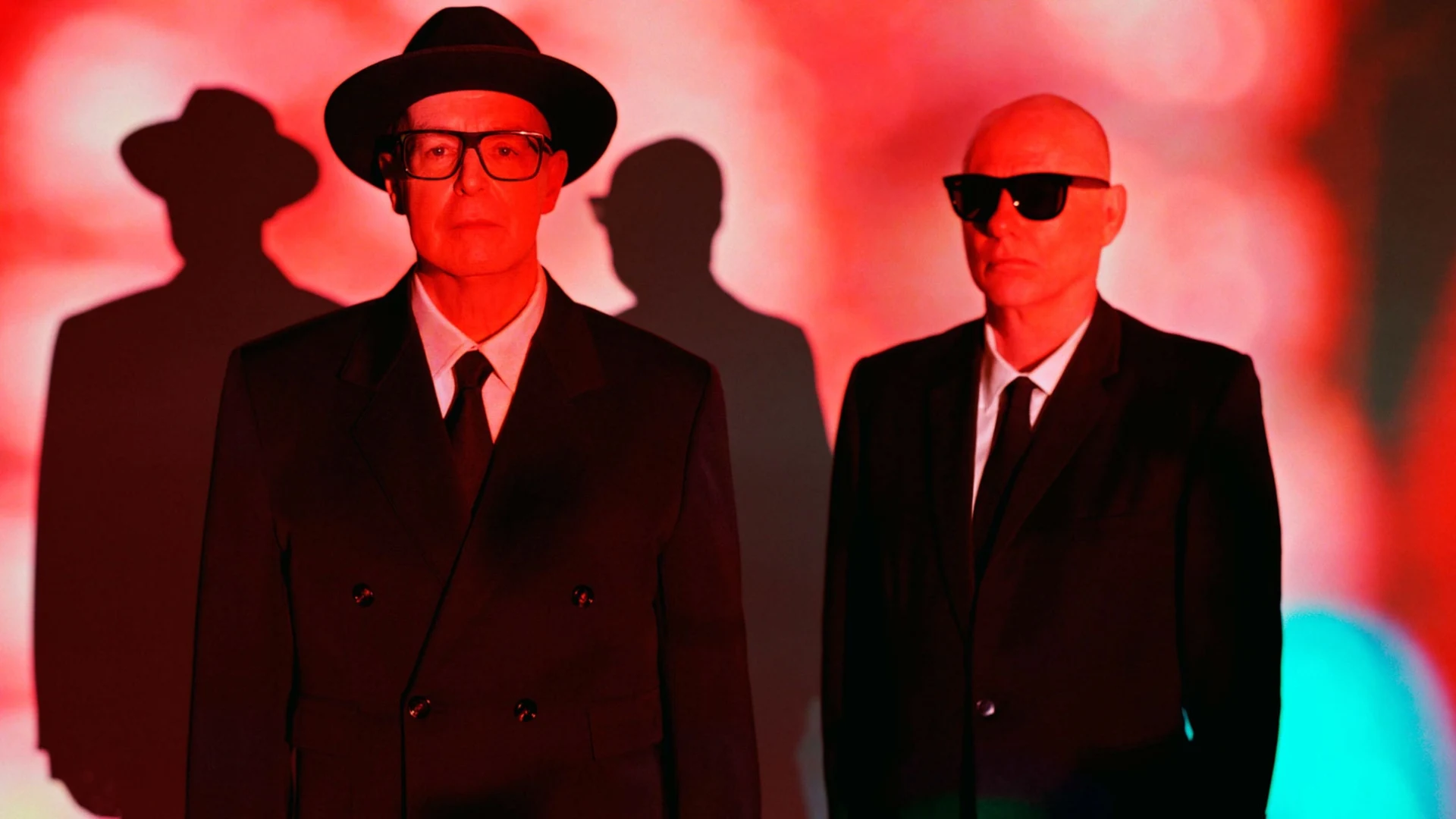
The Pet Shop Boys aren’t just part of British pop culture; they’re one of its cornerstones.
More than any other act, they helped to crystallise the idea of the stylish and sophisticated synth-pop duo – wry, urbane Neil Tennant sings the songs; dry, deadpan Chris Lowe plays them on the keys. Their seemingly bottomless well of modern disco bangers – ‘West End Girls’, ‘It’s a Sin’, ‘Left to My Own Devices’, ‘Se a vida é (That’s the Way Life Is)’, ‘Love etc.’ – has supplied a dynamic and danceable soundtrack to our lives, with lots of pithy social commentary baked in. “I’ve got the brains, you’ve got the looks, let’s make lots of money,” Tennant sings on 1986’s ‘Opportunities (Let’s Make Lots of Money)’, one of the duo’s 44 UK Top 40 hits. Back then, it was a comment on shameless 1980s capitalism; now, it sounds like the game plan of any wannabe influencer.
Back in 1994, when Tennant came out in a now-legendary Attitude cover story, he said with characteristic precision and a hint of defensiveness: “I do think that we have contributed, through our music and also through our videos and the general way we’ve presented things, rather a lot to what you might call ‘gay culture’… And the simple reason for this is that I have written songs from my own point of view.”
Now, more than three decades later, no one could deny that the duo’s contribution to gay and queer culture has been momentous, and continues on their 16th and latest studio album, A Man from the Future, out 9 October, which tells the story of Second World War codebreaker Alan Turing. Prosecuted for being gay during his lifetime, Turing was then subjected to horrific torture through state-sanctioned chemical castration – only to be venerated as a national hero many decades after his death by cyanide poisoning. Who else but the Pet Shop Boys would think to make such a record?
Equally, no one else could take an obscure Village People song about gay men moving to San Francisco, ‘Go West’, and turn it into an enduring queer anthem that doubles as a globally popular football chant.
A legendary legacy
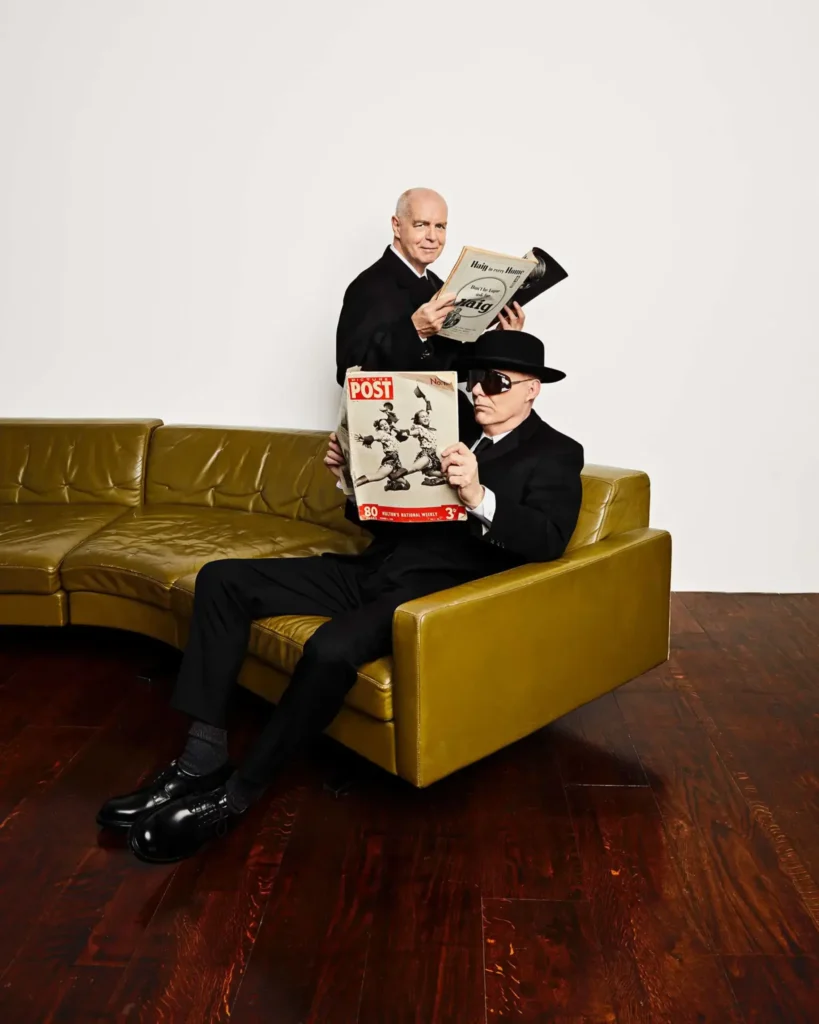
Screenwriter and playwright Jonathan Harvey tells Attitude that the Pet Shop Boys were “incredibly generous” when they worked together on a West End musical, 2001’s Closer to Heaven. “It was a dream come true for me, as I’d loved their music while I was trying to work out how I fitted into the world as a young gay man,” Harvey says. Some Pet Shop Boys songs make you smile – “she’s made you some kind of laughing stock, because you dance to disco and you don’t like rock,” Tennant sings on 1993’s ‘Can You Forgive Her?’, a cautionary tale about staying in the closet. Others, like 1990’s ‘Being Boring’, on which Tennant remembers a close friend who died of AIDS, are quite capable of making you cry. So, all in all, the Pet Shop Boys are ridiculously worthy recipients of The Legend Award, supported by Virgin Atlantic, at this year’s Virgin Atlantic Attitude Awards 2026, in partnership with M&S and electrified by Polestar.
This doesn’t mean, however, that Tennant and Lowe ever devote much time to contemplating their own legacy. “History is looking back; legacy is looking forward,” Tennant says crisply. “Can you even influence your legacy?” He’s sitting directly opposite Lowe, his bandmate of 45 years, in a high-ceilinged room at London’s suitably stately Somerset House.
“Also, it can change over time,” Lowe points out. “Look at Churchill – he died a national hero, but I’m sure his [popularity] rating has plummeted in recent years.”
In person, Tennant is every bit as articulate and well informed as you’d expect, while Lowe is a little more playful than his scrupulously private persona might suggest. Today, he isn’t wearing his trademark shades and baseball cap – borderline shocking to this long-time PSB disciple – but otherwise gives very little away.
Still, there’s no such thing as a pat answer from this pair. When Attitude asks if each considers the other his “best friend” – a pretty sentimental question, admittedly – it leads to a witty critique of “daytime TV culture” and its increasingly “infantile” tone. “Having a ‘best friend’ is just a bit juvenile, isn’t it?” Tennant offers. “It’s like when people [on TV] put their hand to their mouth in shock when someone says a rude word. It’s a pose that adults simply don’t do in real life.” As Attitude finds out over the next couple of hours, spending time with the Pet Shop Boys is a thoroughly grown-up experience.
The pop kids
Each Pet Shop Boy is, to borrow the title of a beloved B-side, a ‘Sexy Northerner’. Lowe, 67, was born and raised in Blackpool, Lancashire, while Tennant, 72, grew up in Gosforth, a suburb of Newcastle. The future bandmates met in 1981, quite by chance, at an electrical shop in west London. At the time, Tennant was a journalist who was soon to join music magazine Smash Hits; Lowe was an architecture student who could already play the keyboards. They bonded over a shared love of synth-pop, disco and hip-hop, then started writing songs together. “We didn’t launch the Pet Shop Boys as a sort of ‘gay project’,” Tennant recalls. “And in the 80s, we used to get a certain amount of criticism about that because you had people – Bronski Beat in particular, and maybe Frankie Goes to Hollywood – who were being launched as a gay project, and that was quite an exciting thing.”
This is an excerpt of a feature appearing in Attitude’s November/December 2026 issue.