
David Furnish on AIDS, Elton John and becoming the world’s most famous gay couple (EXCLUSIVE)
This is an excerpt of a feature appearing in Attitude’s November/December 2026 issue
By Dale Fox
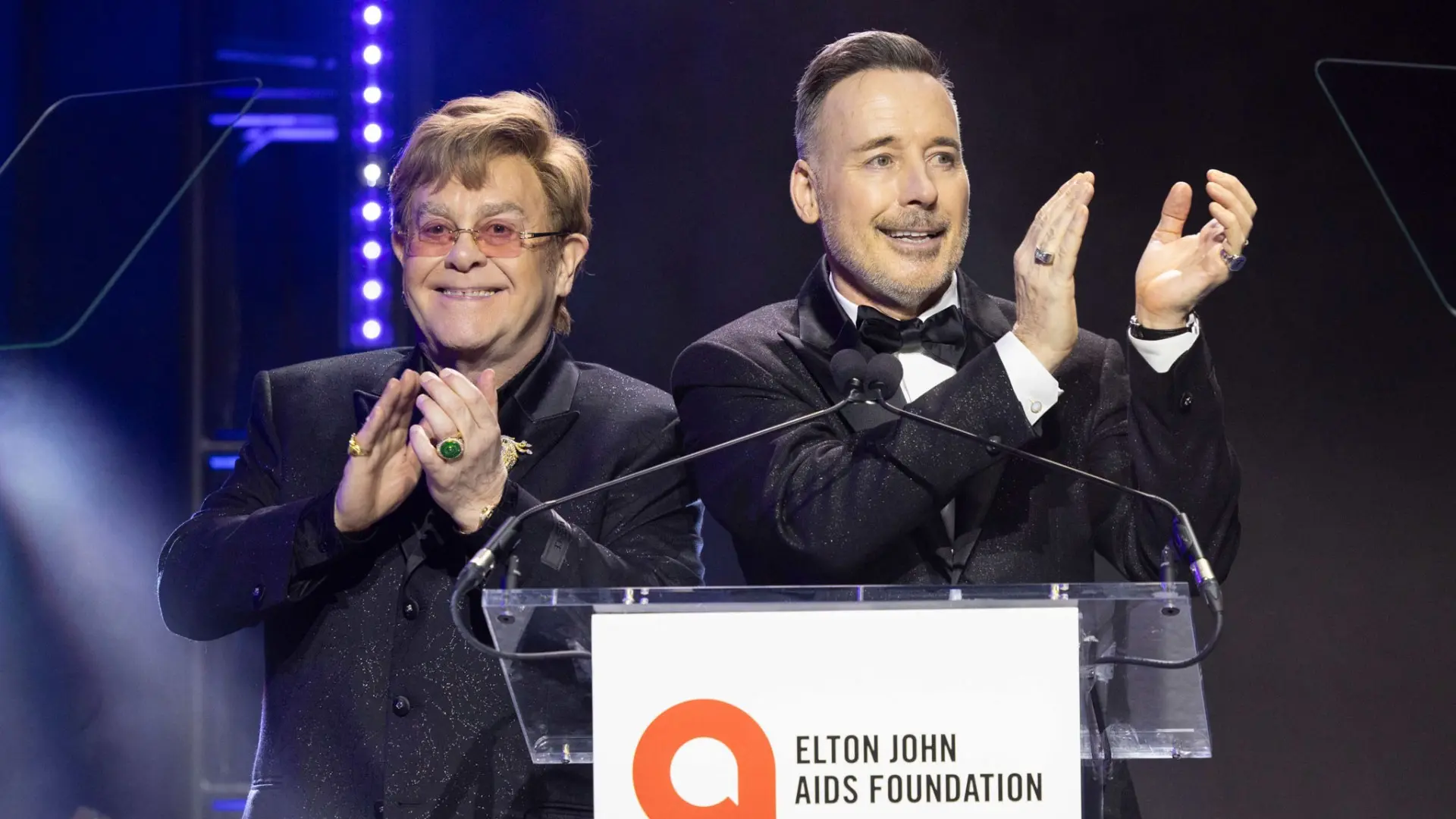
David Furnish’s mind goes back three decades to a business school in Canada when I ask what being named a “gamechanger” means to him. “In the 80s, a decade where I was becoming a man and trying to figure out who I was, there were no role models that I could aspire to at all,” he says. He had “professional business aspirations” at the time and couldn’t find a single openly gay businessperson or philanthropist who looked settled, successful and happy. “I couldn’t find anybody.”
He remembers trying to come out to his mother, who told him that everything that had brought her happiness – marriage and children among them – would not be available to him. “I’m incredibly lucky,” he says. “I’m living in a world now I could never have imagined. So that means a lot, the fact that, to me, the game has changed.”
Meeting Elton

Furnish met Elton John at a dinner party in 1993, and the two have been together ever since: they entered a civil partnership on 21 December 2005, the first day such ceremonies were legally possible in England and Wales, then married on the same date in 2014. “There wasn’t a deliberate campaign… or anything like that,” Furnish says of incidentally becoming the world’s most famous gay couple. “I think it was more of a… desire to live our life honestly and to live our life openly.”
What that gave them, alongside a healthier way to live, was a platform, built on John’s fame as a musician, that they could turn towards the Elton John AIDS Foundation (EJAF). “Both Elton and I survived the 80s when there was no hope for HIV/AIDS,” he says. They lost friends to it and watched people die isolated deaths, abandoned by families, turned away by hospitals. “You can’t help but be, as a gay man, profoundly affected by that.”
Spearheading the Elton John AIDS Foundation
Founded in 1992, the foundation Furnish now chairs has grown into one of the leading AIDS charities in the world. Asked what he is proudest of about it, he starts with fundraising. “That’s been my primary area and drive,” he says, referencing the White Tie and Tiara Ball, EJAF’s former flagship annual UK event, which ran from 1999 to 2013. “We changed the culture of fundraising in Britain,” he says of the event, which introduced ticket prices and auction lots at a scale nobody had tried before. One year alone raised just over £47 million. At its peak, in 2008, a single night brought in £10.8 million. “We broke the barrier with the £1,000 ticket price,” he says. “We never rested on our laurels.” Other UK fundraising galas later adopted the same model, scaling up their own events to match. Indeed, the creation of Attitude’s own charity foundation was inspired directly by EJAF, with proceeds from all Attitude events raising money for LGBTQ+ causes. Royal Holloway University also awarded David a doctorate in 2025 for his work on HIV/AIDS.
Treatment is prevention

Furnish is equally proud of quieter yet harder-won wins. When he and Anne Aslett, the foundation’s chief executive, took a proposal for opt-out HIV testing to Jeremy Hunt, the then health secretary, they were turned down outright, in the middle of a decade of NHS austerity. “There was no money to invest now to save money in the future,” was the response, he says. So, the foundation built one of the world’s first social impact bonds instead, using private philanthropic money to trial routine testing in the three London boroughs with the highest rates of undetected HIV, and let the results make the case. That pilot has since grown into the NHS’s opt-out testing programme for blood-borne viruses in emergency departments, launched in 2022 as part of the government’s national HIV Action Plan. Furnish puts the government’s total investment at around £200 million; the programme now runs across 89 hospitals in England, and has expanded to cover hepatitis B and C alongside HIV. Between April 2022 and August 2026, the programme has led to more than 16,000 new diagnoses of HIV, hepatitis B and hepatitis C. “Treatment is prevention,” Furnish affirms.
Asked which single moment about his foundation work has stayed with him, he goes back further, to hospital wards with no treatment at all. The foundation paid to improve the food served on AIDS wards at Chelsea and Westminster Hospital, and Furnish still hears from people who remember it decades on. He recalls being told: “‘I had oral thrush and I felt terrible and I was rapidly losing weight, and this little card appeared on my tray telling me the meal I’d got was thanks to EJAF.’”
Furnish also describes cutting the ribbon on the world’s first men’s sexual health clinic in Africa, just outside Cape Town, as “a very, very moving moment”. That clinic led, in 2015, to a joint $10-million fund with the US government’s PEPFAR programme, aimed at improving gay men’s sexual health across the developing world.